
Not long ago, Phuket was seen mainly as a vacation destination — a place people visited for a couple of weeks for sun, sea, and Thai exotic vibes. Today, things have changed: the island is becoming a full hub for permanent living in Phuket, remote work, and serious real estate investment, while practical tips help newcomers adapt faster and make more informed decisions.
What is behind this transformation? Year round warm climate, developed infrastructure, relatively affordable prices, and the ability to combine comfortable living with potential passive income.
In this article, we will honestly explore not only the advantages but also the limitations of living in Phuket — from climate особенностей and visa nuances to the legal specifics of property ownership. We will also review different areas of Phuket and their differences in terms of lifestyle and investment, and compare the island with other popular Asian destinations, including Bali, to assess risks and protect capital.
Before packing your bags or planning investments, it’s important to understand whether Phuket is really the right fit for you. Moving to a tropical island is a serious decision, and the experience can vary greatly depending on the person.
Phuket attracts very different groups of expats, each with their own reasons for choosing the island. Over time, several main categories of long-term residents have сформувалися:
It’s important to understand that Phuket is neither a quiet village nor a мегаполіс. It is a developed resort region with its own rhythm and specifics. Those seeking complete isolation or big city intensity may be disappointed. The ideal Phuket resident is someone who values the balance between infrastructure and nature, accepts сезонність tourism, and can adapt to local culture.
When planning a move or real estate investment in Phuket, it’s important to realistically assess all the advantages of the island. Most people who relocate say that reality exceeds expectations, but only if they have thoroughly researched local life in advance.
Phuket’s main advantage is its diversity. Each area has its own atmosphere: lively tourist Patong, upscale Bang Tao with the Laguna complex, quieter family friendly Rawai and Nai Harn, and authentic Phuket Town. This allows everyone to find a location that matches their lifestyle and budget.
What really makes Phuket an attractive place to live and what is the cost of living in Phuket:
It’s important to understand that these advantages vary depending on your lifestyle. For example, families will value safety and activities, while freelancers will focus on coworking and community. Phuket stands out for its diversity, allowing everyone to shape their own lifestyle. The real question is whether you’re ready for that flexibility.
It wouldn’t be fair to talk only about the advantages. When planning a move, it’s important to understand the monthly cost of living in Phuket and the challenges newcomers face — from seasonal expenses to adapting to the climate and local rules.
This understanding helps you make a balanced decision and prepare for potential difficulties without illusions.
Most downsides are related to the tropical climate, tourism dynamics, and cultural differences. Many newcomers go through an adaptation phase, where initial excitement gives way to a more realistic view of local life.
Here are the main challenges expats face in Phuket:
It’s important to note that most of these downsides can be minimized with proper planning. For example, climate-related issues can be addressed by choosing housing with good ventilation and dehumidifiers, while transport challenges depend on choosing the right area. Visa limitations can be partially solved through investment or Elite visas if your budget allows. Next, let’s look at how life in Phuket works for families with children, as they are one of the most demanding groups of residents.

Moving with children is a separate story that requires careful planning. For many families, the quality of life for their children becomes the key factor when choosing a relocation destination. Phuket offers good conditions for families, but there are important nuances to consider.
For families, the question of what children will do in Phuket is closely tied to the quality of education and development opportunities. The island has international and bilingual schools of various levels.
The most prestigious schools — British International School, QSI International School, and Headstart International School — offer International Baccalaureate programs as well as British or American education systems. Tuition ranges from 250,000 to 350,000 baht per year in mid-range schools to 500,000–700,000 baht in premium ones, comparable to private education in Europe but higher than in most Ukrainian cities.
The island’s healthcare infrastructure is well developed. Major international hospitals such as Bangkok Hospital Phuket and Phuket International Hospital provide high-quality services with English-speaking staff and modern equipment. Many doctors were trained in Western countries. A key point is that good health insurance is essential, as medical services for foreigners are expensive. A basic check-up in a private clinic can cost 1,000–1,500 baht (30–45 USD), while serious treatment can run into tens of thousands of dollars.
In terms of safety, Phuket is considered relatively safe with low levels of violent crime. The main risks are related to traffic and water activities. Areas popular among families — Bang Tao, Laguna, Cherng Talay, Rawai, and Nai Harn — offer a спокойная атмосфера, good infrastructure, and proximity to schools.
For families with younger children, there are many kindergartens on the island, from local to international. There are also sports clubs, creative studios, swimming schools, and other activities for kids. Large shopping malls like Central Festival and Jungceylon offer indoor playgrounds and entertainment zones.
When choosing property in Phuket for a family, many prefer villas in quieter areas rather than apartments by the sea. This is due to the need for more space, private outdoor areas for children, and distance from noisy tourist zones. The trade-off is that you’ll likely need a car to reach the beach, but daily life becomes more comfortable.
The main advice for families planning to move is to come for at least a month first, visit schools and neighborhoods, and only then decide on a long-term move or property purchase. Next, let’s look at the cost of living in Phuket and what budget you should plan for.
The cost of living is one of the key questions when planning a move. In Phuket, expenses can vary significantly depending on lifestyle, location, and personal habits. Let’s break down the main categories so you can estimate your budget.
Housing rent is the largest expense for most expats. Long-term rentals for 6–12 months are significantly cheaper than short-term stays.
A studio or one-bedroom apartment in a mid-range condominium away from the beach costs around 10,000–15,000 baht per month. A one-bedroom apartment in a good area near the beach costs 20,000–30,000 baht. A 2–3 bedroom villa in areas like Rawai, Nai Harn, or Chalong starts from 35,000–50,000 baht, while in premium areas like Bang Tao or Laguna prices start from 50,000–60,000 baht per month.
Transport is the second major expense. Most residents need their own vehicle. Renting a scooter costs 3,000–5,000 baht per month (90–150 USD), while a car starts from 15,000 baht (450 USD). Buying a new scooter costs from 50,000 baht (1,500 USD), and a used car from 300,000 baht (9,000 USD). Fuel is relatively affordable at around 40–45 baht per liter (1.2–1.3 USD).
Food costs can be low or high depending on your habits. Eating in local Thai cafes or food courts can cost from 300 baht per day per person (about 9 USD). A meal in an inexpensive restaurant costs 150–250 baht (4.5–7.5 USD), while dinner for two in a mid-range restaurant costs 800–1500 baht (24–45 USD). Supermarket prices are higher than local markets, and imported goods can be 2–3 times more expensive than in their country of origin. Overall, prices in Phuket are higher than in mainland Thailand due to logistics.
Here is an approximate monthly budget for a couple without children (in USD):
For a family with a school-age child, the budget will differ, especially if you plan long-term living with expenses for healthcare, education, and stable living conditions.
Compared to Kyiv, living in Phuket can be cheaper for a similar quality of life, especially if you’re ready to adapt to local products and lifestyle. Compared to Bali, Phuket is slightly more expensive in terms of rent and food, but offers more developed infrastructure.
When planning long-term living on the island, it is important to understand the financial and investment risks in Phuket. Buying property instead of renting can indeed optimize your budget, especially with a 5–7 year horizon, but only if the location and legal structure are chosen correctly.
Mistakes in property selection, unrealistic yield expectations, or poor management can eliminate these benefits. That’s why it’s important to separately assess the island’s investment potential and associated risks.
Phuket attracts investors for several reasons. First, it has a stable tourist flow that drives rental demand. Second, the island’s limited land supply naturally restricts inventory, supporting prices. Third, developed infrastructure and international status make it a liquid market with clear rules.
Phuket’s real estate investment market is quite diverse. The most popular options are condominiums (apartments in residential complexes), condotels (projects with professional management and guaranteed returns), and private villas. Each format has its own specifics.
Condominiums are the easiest entry point to the market. Foreigners can purchase units in freehold ownership if the 49% foreign ownership quota in the project is not exceeded. Entry prices start from 3–5 million baht ($90,000–150,000) for a studio or one-bedroom unit. Rental yields are typically around 5–8% annually.
Condotels attract investors looking for максимально passive income or a vacation-home format in Phuket without the need for self-management. A management company handles maintenance, tenant sourcing, and all administrative tasks.
Guaranteed return programs are often offered, typically 5–7% annually for the first 3–5 years. Entry budgets are comparable to standard condominiums, but service fees are usually higher due to additional services.
Villas require more substantial investments, starting from 10–15 million baht ($300,000–450,000) for a small 2–3 bedroom villa not located beachfront. Yields can be higher than condos, reaching 8–12% annually with proper management and a focus on short-term rentals during high season. However, villa ownership for foreigners is typically structured as leasehold (long-term land lease, usually 30 years with extension options), requiring careful legal structuring.
Many investors successfully follow a “live part-time, rent part-time” model. For example, they stay in Phuket for 3–4 months during high season and rent out the property for the rest of the year. With proper planning, this approach can cover annual maintenance costs and even generate a small profit.
When choosing a property for investment, it is important to consider:
Property prices in Phuket vary depending on the area. The most expensive properties are located on the west coast in Bang Tao, Surin, and Kamala. In these locations, prices per square meter in new condominiums start from 100,000–120,000 baht ($3,000–3,600). In less prestigious areas such as Kathu or Chalong, options can be found from 70,000–80,000 baht ($2,100–2,400) per square meter.
It is important to understand that real estate investments in Phuket, like any international investments, carry certain risks. Changes in regulations, fluctuations in tourist flow, and political instability can all affect returns and asset values. That is why many experienced investors prefer to diversify across different countries and islands. For example, combining assets in Phuket and Bali can provide a more stable portfolio, considering different seasons, tourist segments, and legal frameworks.
In this context, it is worth mentioning Legion Real Estate — real estate experts in Bali who help investors build strategies across different Asian markets. Their experience can be useful when comparing the investment potential of different islands and forming a diversified portfolio. Now let’s look at how to ensure legal long-term stay in Phuket.

Visa matters are one of the key aspects for those planning to live in Phuket long-term. Thailand offers several options for legal long-term stay for foreigners, and the best choice depends on your circumstances, plans, and budget.
First, it’s important to understand that standard tourist visas and visa-free stamps are only suitable for short-term stays. They allow you to stay in the country for 30–60 days with the option to extend for another 30 days at an immigration office. Living for years on such visas through regular “visa runs” is now практически impossible, as Thai authorities actively restrict this practice.
For long-term residence, the following main options are available:
It is important to understand that buying property in Thailand does not grant the right to long-term residence or employment. Unlike some countries, there is no “residency by real estate investment” program. However, property ownership may indirectly support certain visa applications by demonstrating ties to the country and financial stability.
Visa regulations in Thailand change frequently, so it is crucial to work with professional lawyers and visa agencies specializing in immigration. Attempts to bypass the system through “gray schemes” can lead to serious consequences, including entry bans.
A long-term visa strategy should go hand in hand with your investment plans. For example, if you are considering buying property, it makes sense to plan your visa path simultaneously to ensure you can regularly visit or live in your property. After understanding visa options, let’s compare Phuket with another popular destination — Bali.
Phuket and Bali are often compared, and for good reason — both islands attract digital nomads, real estate investors, and those seeking a more comfortable life in the tropics. When choosing a country and island, the question inevitably arises of where it is better to live in Phuket, as different areas vary significantly in infrastructure, comfort level, and investment potential.
These differences are crucial to consider when making a decision, despite the apparent similarity of the destinations.
Climatically, both islands are tropical but have their nuances. Phuket has more pronounced seasonality with a clear division between the dry season (November–April) and the wet season (May–October). Bali has a smoother transition between seasons, although it also has a monsoon period (December–March). Humidity in Phuket is generally higher, which may be uncomfortable for some people, especially those with respiratory issues.
In terms of infrastructure, Phuket often comes out ahead. It has better roads, more modern hospitals and shopping malls, and more stable electricity. Bali faces more severe traffic congestion, especially in popular areas like Canggu and Seminyak. At the same time, Bali offers a more developed ecosystem for digital nomads, with numerous coworking spaces and creative hubs.
In terms of real estate investment, Phuket allows foreigners to directly own condominiums under freehold (within the 49% quota), making the process more transparent and secure. In Bali, foreigners usually use various ownership structures — from hak pakai (right of use) to setting up a PT PMA (foreign-owned company). This requires more complex legal support but can deliver high returns if structured properly.
Culturally, Phuket is more oriented toward mass tourism and a “European-style” lifestyle, while Bali has preserved more of its unique cultural identity and spiritual atmosphere. This is especially noticeable when comparing typical areas — for example, the lively tourist hub of Patong in Phuket is very different from bohemian Canggu or spiritual Ubud in Bali.
Different islands suit different goals. If you value predictability, stable infrastructure, and simpler legal processes, Phuket may be the better choice. If you prioritize unique culture, a creative environment, and are willing to accept some infrastructure limitations, Bali might suit you better.
Many investors conclude that the optimal strategy is diversification across both destinations. Legion Real Estate, specializing in Bali real estate, helps clients build a balanced strategy that leverages the strengths of each island. Now that we have an overview of both markets, let’s look at practical steps for preparing to live in Phuket.
Making a decision to move or invest in Phuket is only the first step. What follows is careful preparation that helps avoid common mistakes and disappointments. The right approach allows you to maximize the island’s advantages and minimize potential challenges.
A successful move or investment starts with detailed planning, testing, and gradual adaptation. Here is a step-by-step approach to help you prepare:
Climate considerations. For example, September in Phuket is characterized by high humidity, rain, and heat, so gradual adaptation is important, especially if you are coming from a colder region.
If you are considering not only Phuket but also Bali or want to diversify your investments, compare prices, entry conditions, and potential returns in advance. This helps you better evaluate your budget and risks.
Legion Real Estate can handle the analytical and legal aspects of Bali investments using local expertise. This approach reduces the risk of mistakes and helps build a more resilient investment strategy.
Before drawing conclusions, it is important to highlight the key points about living and investing in Phuket, including real estate prices that directly influence strategy and market entry decisions.
These points help form a clearer understanding of the opportunities and challenges associated with this destination.
Living in Phuket is not just a move to a place with beautiful beaches, but a full lifestyle change including climate, environment, and often income structure. For those ready for this, the island can be a strong option for both permanent and seasonal living.
Phuket suits those who want an international environment, warm climate, and proximity to nature while still having access to urban infrastructure. Families get safety and education, remote professionals get stable internet and community, and investors get a transparent market with potential. The key is to make decisions based on analysis rather than эмоції, considering goals, budget, and strategy. Combining different markets or working with experts helps reduce risks and build more stable long term investments.
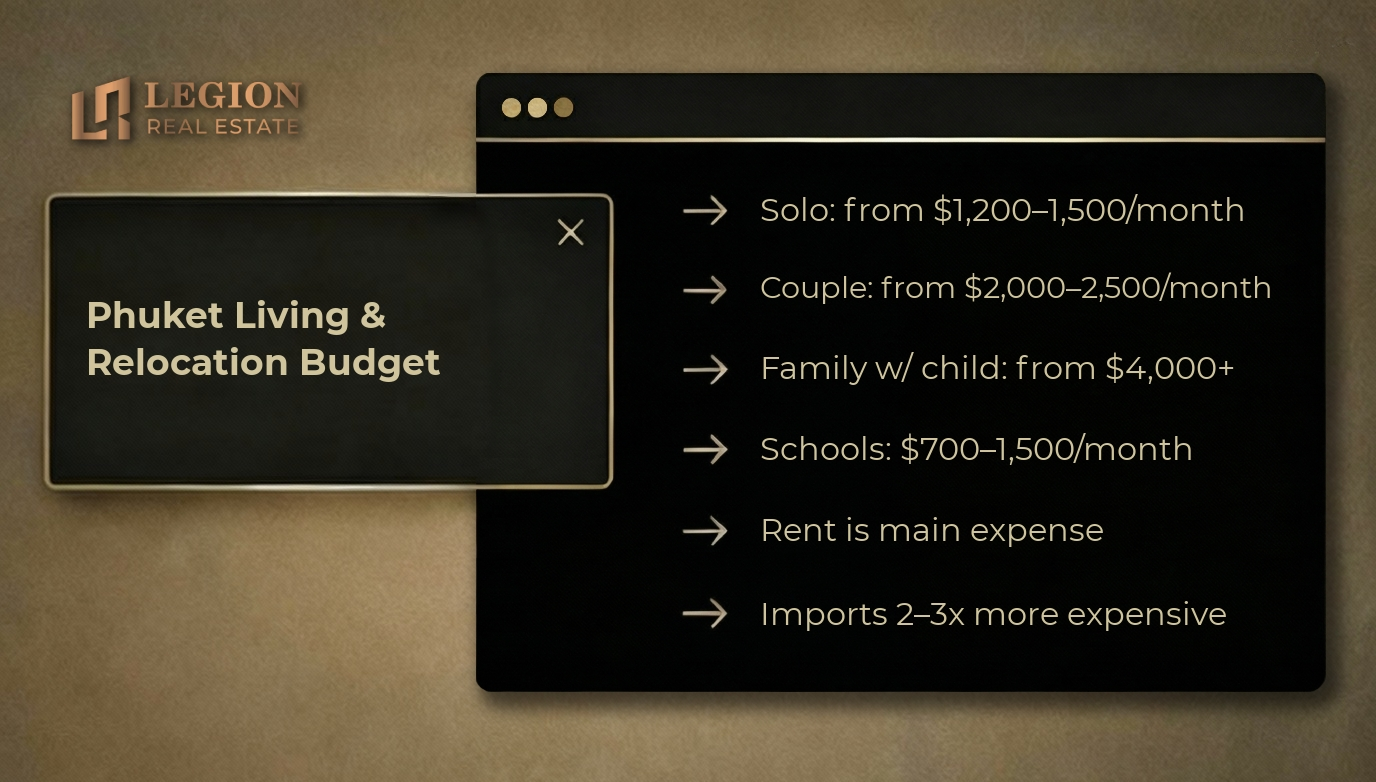
The minimum comfortable budget for one person starts from $1,200–1,500, for a couple — from $2,000–2,500, and for a family with a child — from $4,000 and above. These figures strongly depend on lifestyle, area of residence, and seasonality, especially during peak demand periods such as New Year in Phuket, when rent and daily expenses temporarily increase.
To do this, you need to visit the immigration office in Phuket Town. Depending on the type of visa, different documents will be required: proof of income or funds in a bank account, medical insurance, proof of property ownership or rental, and others. The extension usually takes from a few hours to a few days.
The island offers many activities for different interests: from water sports (diving, snorkeling, surfing, kiting) to cultural and экскурсионные programs (temples, old town, islands). For those planning to stay long term, there are various fitness clubs, yoga studios, creative workshops, and educational courses. Nightlife in Phuket is especially active during the high season, from November to April, when many festivals, parties, and cultural events take place.

.webp)


