
Bali in 2026 is no longer an exotic “paradise for travelers,” but a mature resort market with clear segmentation by areas and property formats. The rental market in Bali in 2026 is driven by three powerful sources: steadily growing international tourism, an increasing number of digital nomads and expats, and a shift toward longer stays — from weeks to months and even years.
For investors, the situation has changed dramatically. The days when you could simply “buy a villa by the ocean” and earn passive income are over. Today, success in the Bali rental market requires precise location selection, proper legal structuring, and professional property management. In this article, we rely on актуальные market data and Legion Real Estate cases to show how to correctly assess demand and where it makes sense to invest in 2026.
Bali has evolved from a “two-week vacation destination” into a полноценное place for living, working, raising children, and a wellness-oriented lifestyle. This shift in perception has fundamentally changed the structure of rental demand. Previously, most tenants were short-term tourists, but today the picture is far more complex and diversified.
Today, four main tenant categories can be identified, each contributing to overall housing demand in Bali. First, tourists, who still represent a significant share of the market, especially during peak seasons, and are willing to pay high rates for short-term rentals. Second, digital nomads and freelancers renting for periods from 1 to 3 months. Third, families and entrepreneurs renting for longer terms — from six months or more. Finally, the fourth category consists of investors living by the “half year here / half year there” model.
Interestingly, rental demand seasonality in Bali is gradually smoothing out. While a few years ago there were sharp peaks and declines, many properties now maintain stable occupancy year-round. This is due to long-term tenants not being tied to туристические сезоны and choosing move-in timing based on personal circumstances.
It is important to note that demand growth is driven not only by an increase in the number of people, but also by the emergence of professionally managed projects with hotel-level service, offering higher comfort. Legion Real Estate actively guides clients toward such projects, as they ensure better occupancy rates and higher rental prices. This market transformation opens new opportunities for investors ready to follow modern trends.
Canggu remains one of Bali’s most popular areas, with high building density and a well-established brand. There is consistently strong demand for rental property here, but it is important to note that real estate price growth has largely already played out. Rental rates and occupancy in Canggu heavily depend on concept and management quality. Standard villas without distinctive features face intense competition, while unique properties continue to attract strong demand.
Pererenan, located next to Canggu, is a more premium and less saturated location. It still offers growth potential in both property prices and rental rates. Demand here is driven by more affluent tenants who value comfort and relative спокойствие compared to busy Canggu.
In both areas, compact 1–2 bedroom villas and apartments in well-equipped complexes are the most востребованные. Average occupancy of quality properties is around 70–80% annually, allowing yields of approximately 8–12% per year.
The Bukit area, including Uluwatu, Bingin, and Nusa Dua, is characterized by limited land supply, beautiful beaches, and active development of new resort complexes. Demand here comes from two main segments: tourists and surfers preferring short-term villa rentals, and investors interested in purchasing property within professionally managed developments.
Uluwatu demonstrates some of the highest rental yields in Bali. According to market data, the average daily rate (ADR) here is $255, significantly higher than in other areas of the island. Premium villas can generate up to 18% annual returns when properly managed.
The growth potential in Bukit is also supported by new infrastructure projects, including road development, the opening of high-end clubs, and international schools. These factors make the area attractive for long-term investment.
Ubud attracts a completely different type of tenant compared to coastal areas. Demand here comes from retreat centers, families, wellness tourists, and digital entrepreneurs. Unlike Canggu, Ubud offers a quieter lifestyle, creating demand for green, secluded villas.
Although rental rates in Ubud are lower than in oceanfront areas, rentals here tend to be longer and more predictable. Many tenants sign contracts for periods from six months to a year or more. Wellness villas with appropriate infrastructure (yoga spaces, spa areas, organic kitchens) show returns of 12–18% annually, making this segment one of the most promising in Bali.
Sanur is becoming increasingly popular among families and retirees due to its развитая infrastructure, спокойная atmosphere, and good beaches. The area shows stable demand for long-term rentals with minimal seasonality.
The expanding belt around Canggu, including areas such as Berawa and Batu Bolong, offers more affordable options for investors while maintaining relatively strong rental demand. New developments near the airport and major hubs are also of interest from an investment perspective.
Legion Real Estate closely monitors the development of these locations and evaluates their rental potential over a 3–5 year horizon. Our analysts believe that some of these areas may show significant rental growth in the coming years, especially as new infrastructure projects are implemented.
Choosing the right property format is one of the key success factors for investment in the Bali rental market. Market analysis shows that different types of properties attract different tenant categories and, accordingly, provide different levels of yield and occupancy.
1–2 bedroom villas remain the most popular format among tenants. They attract couples and small families willing to pay higher rental rates for privacy and comfort. Such villas perform well in both short-term and mid-term rental segments. The average yield for compact villas is 12–18% annually, making them attractive investment assets. A villa for rent in Bali is one of the most востребованных search queries among tourists.
Apartments and studios make up a significant share of the Bali rental market. They are in high demand among digital nomads, singles, and couples. Although the average rental price for apartments is lower than for villas, they provide more stable occupancy, especially when located in complexes with strong infrastructure and services. Renting an apartment in Bali is becoming increasingly popular among long-term tenants, with average yields of 10–14% annually.
Interest in townhouses and duplexes is growing among family tenants planning stays of 3–6 months. This format offers a balance between villa privacy and the security of living in a managed complex, making it attractive for a specific segment of clients.
Notably, according to market data, smaller formats (studios, one-bedroom apartments, compact villas) are easier to rent out and resell. This is due to their affordability for a wider audience of tenants and buyers, as well as better alignment with the needs of the growing digital nomad segment, for whom functionality matters more than large площади. When selecting an investment property, this trend should be considered, and compact formats should be prioritized if your goal is to maximize rental yield.
Before investing in Bali real estate, it is important to have a realistic understanding of potential rental returns. Market data for 2026 allows for a fairly accurate estimate of expected profits across different segments.
Average market yields vary depending on property type and location. Apartments in good locations generate approximately 10–14% annually, compact villas 12–18%, and more conservative long-term rental properties 7–10%. However, these are average figures, and actual results may differ significantly both upward and downward.
Let’s look at a specific example of yield calculation for a two-bedroom villa in Canggu priced at $150,000:
It is important to note that actual yield depends on multiple factors, including seasonality, management quality, and competition in the selected area. Therefore, when evaluating a potential investment, Legion Real Estate always conducts a detailed analysis, taking into account the specifics of each property.
Our specialists analyze occupancy rates by area and segment, perform stress testing of returns under reduced rates or occupancy, and assess the potential for asset value growth. This comprehensive approach allows investors to make informed decisions based on real market data rather than marketing promises.

Why can two similar properties in the same area show a difference in yield of up to 30–40%? The answer lies in details that are not always obvious during initial evaluation but are critical for financial results.
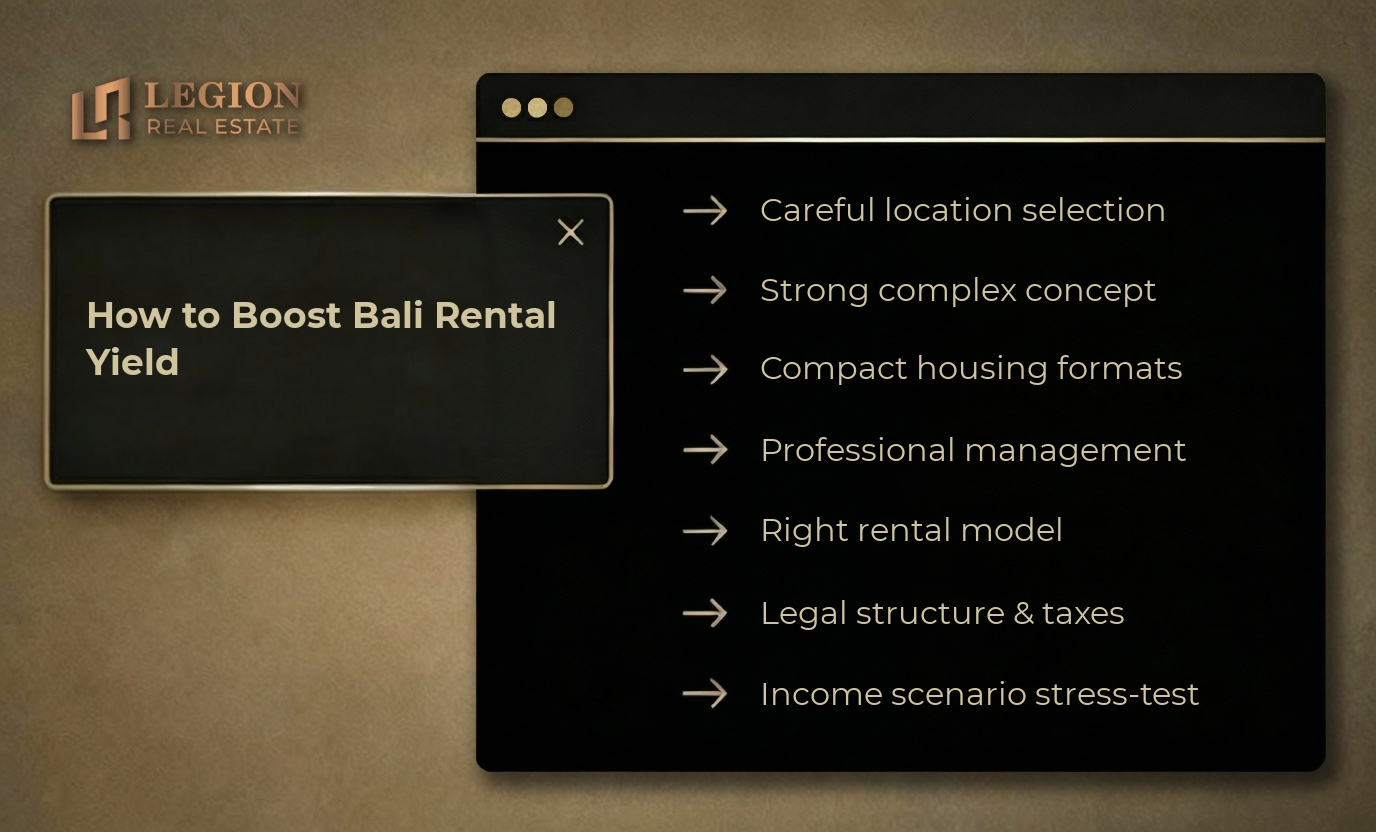
In our practice, we highlight several key factors that determine the real rental yield of a property in Bali:
Legion Real Estate filters projects based on these parameters already at the selection stage, allowing our clients to invest only in properties with high yield potential. We exclude projects that may look attractive on paper but have hidden drawbacks that can significantly reduce real returns.
We pay special attention to management. Practice shows that even a perfectly located property can become unprofitable with poor management. Therefore, we recommend always including professional management costs in your calculations — this is an investment that pays off multiple times through higher occupancy and rental rates.
A legally sound approach to renting in Bali is not just a formality but a necessary condition for a sustainable business. It is important to understand that renting out property in Indonesia is considered a business activity and requires proper registration. You cannot simply arrive on a tourist visa and start renting out real estate.
There are two main models for legally operating a rental business in Bali:
Regarding taxes, the property owner must be prepared to pay income tax (20% for non-residents, up to 35% on a progressive scale for residents) and value-added tax (11% in 2026). In addition, management fees and marketing expenses should be considered, which may amount to 15–25% of gross revenue.
Legion Real Estate helps its clients navigate all legal complexities and choose the optimal operating model. We can recommend trusted lawyers and tax consultants, verify how a specific project or developer formalizes rental activities, and ensure transparency in payment structures for the owner. Our experience shows that investments in legal compliance always pay off, especially in the long term.

Choosing the right rental model is one of the key decisions that determines not only the return on investment but also the level of your involvement in property management. In Bali in 2026, three main rental formats can be identified, each with its own characteristics.
Short-term rental (days or weeks) is offered through platforms such as Airbnb and Booking.com and provides the highest income potential. However, this format requires active marketing, continuous work with reviews, and involves higher operational costs. To succeed in short-term rentals, the property must be located in a popular tourist area and offer a high level of service.
Mid-term rental (1–3 months) is especially popular among digital nomads. This format is less sensitive to seasonality and is suitable for apartments and townhouses. Monthly rentals in Bali provide a good balance between income stability and size while requiring less operational effort than short-term rentals.
Long-term rental (6–12 months and more) offers the most stable rates and minimal operational hassle. Returns are usually lower but more predictable. This format is ideal for villas in residential areas and for investors who prefer a passive management approach. Long-term rentals in Bali are becoming increasingly popular among families with children and business professionals relocating to the island.
Our experience shows that for a conservative investor, the optimal approach is a combination of mid-term and long-term rentals. This strategy provides stable income with minimal risk. For a more aggressive strategy, a resort format with a short-term model and a strong management company is suitable.
Legion Real Estate selects not only the property but also the rental model based on the required risk and return profile of the client. We take into account all factors, including location, property characteristics, and market conditions, to offer the optimal solution.
In recent years, the Bali rental market has undergone significant changes that must be considered when planning investments. The market has become more mature and professional. Buyers and tenants now pay attention not only to “beautiful renders” but also to the developer’s reputation, competitive environment, and potential exit strategies.
Market growth has become more selective. While prices previously increased across almost all areas of the island, now only strong projects in high-demand locations are winning. This creates opportunities for targeted investments but requires more thorough analysis of each property.
Management and service have become critical factors for rental yield. Professionally managed properties show significantly better results in terms of occupancy and rates compared to those managed independently by owners.
As for trends for 2026–2027, several key directions can be highlighted:
Legion Real Estate adapts its clients’ strategies to these trends, focusing on a long-term investment horizon, emphasizing concept-driven projects, and conducting thorough stress testing of rental yields. Our goal is to ensure not only high current income but also sustainable capital growth in the long term.
2026 is a time for strategy, not impulsive purchases. Demand for rentals in Bali exists, but it works only in the combination of “right property + right model.” To maximize chances of success, investors should follow a clear action plan.
After defining the basic parameters, we recommend contacting Legion Real Estate specialists to narrow down the range of areas and formats that match your goals and budget. Our experts will conduct a comprehensive market analysis and offer optimal investment options.
The next critical step is legal and financial due diligence of the selected project or property. This helps avoid unpleasant surprises and ensures the legality and transparency of the transaction. Then it is necessary to model rental returns using conservative, base, and optimistic scenarios.
It is important to decide in advance how the property will be managed: will you work with a management company, join an operator pool, or create your own structure. Finally, you need to plan your exit strategy: to whom and how you will sell the property in a few years.
Legion Real Estate is ready to support you at every stage of this process, providing professional guidance and minimizing risks. We offer property подбор with detailed rental yield calculations and various development scenarios, helping our clients make well-informed investment decisions. You can learn more about the best areas for investment and strategies on the relevant page.
The rental market in Bali in 2026 remains structurally strong but uneven. The winning factors are the right locations, formats, and management models. Investors need to understand that Bali can no longer be seen as a speculative market — it is a mature resort ecosystem where legal clarity, stable occupancy, and risk management are essential.
With returns of 10-15% annually and potential for asset value growth, Bali retains its position as one of the most attractive resort real estate markets for international investors. However, success in this market requires a professional approach and a deep understanding of local specifics. Legion Real Estate provides clients with demand analytics in specific areas and a tailored entry strategy based on verified projects, transparent legal structures, and well-designed rental models.
The Indonesian real estate market shows steady growth with a focus on high-quality projects. Resort areas in Bali and professionally managed developments are especially promising.
Bali is undergoing a transformation toward a more professional market with increased regulation and growth in high-quality projects with hotel management.
Average returns are 10-15% annually for high-quality properties with professional management. Villas can yield up to 18%, apartments 10-14%.
Absolutely, Bali remains one of the top travel destinations with developed infrastructure and a unique culture.
The market will become more segmented with a clear differentiation between premium and mass-market properties. Demand for managed developments is expected to grow.
Indonesia will continue to develop as one of the largest economies in Asia, with a growing middle class and increasing domestic demand for real estate.
Tourists can enter visa-free for 30 days or obtain a visa on arrival. For long-term stays, appropriate visas or permits are required.


.webp)


