
Thailand has long attracted Russian-speaking investors with its resorts, warm climate, and real estate investment opportunities. However, behind this attractive image lies a complex legal system where choosing between freehold and leasehold becomes a key decision for any foreign buyer.
Why does this matter? Because the type of ownership directly affects not only the duration of your property rights, but also resale opportunities, tax obligations, inheritance issues, and ultimately the return on investment. Imagine investing a significant amount in a villa in Phuket or a condo in Bangkok, only to discover a few years later that your rights are limited or even at risk. Such situations are not uncommon among unprepared investors.
In this article, we will explore the nuances of freehold and leasehold in Thailand, compare their advantages and disadvantages, and share practical tips to help you make an informed decision and protect your investment. Our approach is designed for those who seek not only passive income but also reliable capital protection in Thailand’s dynamic property market.
Before deciding to purchase property in Thailand, it is essential to clearly understand the difference between the two main forms of ownership. These legal concepts determine your rights, obligations, and potential risks throughout the entire ownership period.
Freehold is a perpetual ownership right to property and is the closest concept to full ownership. A freehold owner has complete rights over the property: they can own it indefinitely, freely manage it, sell it, gift it, or pass it on through inheritance without additional approvals. In Thailand, freehold ownership for foreigners is mainly available for condominium units and comes with certain limitations that will be discussed later.
Leasehold, in contrast, represents a long-term lease of property for a fixed period. Unlike freehold, the leaseholder does not become the full owner but only receives the right to use the property for a specific period, usually 30 years with a possible extension. When the lease term expires, the property returns to the owner unless an extension is agreed.
The key differences between leasehold and freehold relate to several aspects:
It is important to note that both freehold and leasehold in Thailand must be officially registered with the Thailand Land Department. Without such registration, especially in the case of leasehold, your rights may not be legally protected.
An unregistered lease agreement is a serious risk that can lead to the loss of your investment if the land or property owner changes. Understanding these basic differences between freehold and leasehold is only the first step toward making a well-informed decision that takes into account your long-term goals and investment strategy.
Thai legislation imposes strict restrictions on foreigners who wish to purchase property. These rules make the choice between freehold and leasehold not just a matter of preference, but often the only possible option depending on the type of property.
The main rule foreign investors encounter in condominiums is known as the “49/51 rule.” According to this rule, no more than 49% of the total condominium area can be sold as freehold to foreigners. The remaining 51% must belong to Thai citizens or companies with predominantly Thai ownership. This restriction applies to floor area rather than the number of units, meaning that in some buildings the quota can be filled by just a few large apartments sold to foreign buyers.
Even stricter restrictions apply to land ownership. Foreign individuals cannot directly own land in Thailand under freehold rights, as clearly defined by law. This means that when purchasing a house or villa with land, a foreign buyer must choose one of the alternative ownership structures.

Property ownership practices vary significantly depending on the region of Thailand:
In theory, it is possible to convert a property from leasehold to freehold, but this can only happen if there is an available foreign quota in the building and the owner agrees. In practice, such conversions are rare and usually cost more than purchasing a freehold property directly.
Sometimes foreigners try to bypass the land ownership ban by creating a Thai company with nominee Thai shareholders. However, such structures carry significant legal risks, including potential criminal liability, and are not recommended for long-term investments.
Understanding these restrictions is crucial when planning investments in Thai real estate and helps realistically assess the available options depending on the type of property and your investment goals.
Freehold is the most complete form of property ownership in Thailand, but for foreigners it is available with significant restrictions. Let us examine which properties can be purchased as freehold and what features it has from an investor’s perspective.
For a foreign buyer, true freehold ownership is generally available only when purchasing a condominium unit within the 49% foreign ownership quota. This means that most houses, villas, and land plots cannot be directly owned. Technically, it is possible to own a house or villa through a Thai company, but such a structure carries significant legal risks due to restrictions on the use of nominee shareholders.
A freehold property owner receives the full set of rights: unlimited ownership of the property, the ability to use it as collateral for a loan, freedom to rent it out or resell it without needing approval from third parties. Freehold property can also be fully inherited and passed on to heirs or specified in a will.
What does freehold mean in practice? It is full ownership that gives you maximum control over the property and protects your investment in the long term.
In terms of price, freehold properties are usually 5–10% more expensive than comparable leasehold properties. This price difference reflects the advantages of full ownership and the higher liquidity of such assets. However, the higher entry cost can affect investment returns, especially in the short term.
When purchasing and owning freehold property, you will face several tax obligations:
The main advantages of freehold are:
The disadvantages and risks include:
Freehold remains the preferred option for most long-term investors, especially those planning to pass property to heirs or seeking stable capital appreciation. However, its limited availability for foreigners, particularly in the villa and house segment, leads many investors to consider leasehold as an alternative. More details about ownership structures and property options for foreigners can be found in the section “Ownership Structure for Foreign Buyers.”
Leasehold in Thailand is a popular alternative to freehold, especially when it comes to villas, houses, or apartments in resort areas. This ownership structure has specific features that should be carefully studied before making an investment decision.
A typical leasehold in Thailand is structured for 30 years, with the possibility of two additional 30-year extensions, theoretically giving a total term of up to 90 years. However, it is important to understand that only the initial 30-year period is officially registered with the Thai Land Department. Promises of additional extensions are usually recorded only in a private agreement with the developer or landowner and do not have the same legal force as the primary contract.
What is leasehold in practice? Leasehold is a form of long-term lease that allows foreigners to control property, including villas and houses with land plots, without directly violating Thai ownership restrictions.
Under a leasehold structure, you can resell your lease rights, transfer them as a gift, or pass them on through inheritance, but only for the remaining lease term. In many cases, notification or even approval from the landlord is required. Heirs must also comply with the conditions defined in the original agreement.
One of the main advantages of leasehold is the lower entry cost. Leasehold properties are typically 20–30% cheaper than comparable freehold properties, allowing investors to reduce initial expenses. In addition, the tax burden is usually lower: lease registration tax is about 1% (compared to 2% for ownership transfer), and annual property taxes are often lower or may not apply to the tenant.
Leasehold is more commonly found in the following types of projects:
The main advantages of leasehold include:
However, leasehold also involves significant risks:
Interestingly, some experienced investors use leasehold as a tactical tool for medium-term investments (7–15 years), planning to resell the property long before the initial lease term expires. In such cases, the lower entry price can allow investors to achieve higher percentage returns with proper property management.
The choice between leasehold and freehold often depends not only on the type of property, but also on your investment horizon, risk tolerance, and preferred ownership structure.

Different types of property in Thailand offer foreign investors various ownership structures. Understanding these differences will help you choose a property that matches your investment goals and legal possibilities.
Condominium units (condos) are the most transparent option for foreign investors. Each unit has a separate cadastral number and is registered to a specific owner. You can purchase a condo as freehold if the 49% foreign ownership quota in the building has not been filled (this quota is calculated by total area, not by the number of units). If the quota is already filled, the only option is to purchase under leasehold. When buying a condo as freehold, you receive full perpetual ownership rights, are included in the condominium ownership register, and gain voting rights at owners’ meetings.
Apartments (hotel or serviced apartments) have a fundamentally different structure. Usually the entire building has a single cadastral number and a single legal owner, typically the developer or a management company. Individual units are not registered as separate real estate properties; instead, investors are offered leasehold agreements, meaning a long-term lease of a specific unit with rights to a share of the rental income from short-term stays. You do not receive a separate ownership certificate, only a long-term lease contract. This significantly limits control over the property and makes you dependent on the management company.
Villas offer several possible ownership structures:
When choosing a property, investors usually follow different priorities:
Investors focused on passive income often choose apartments in managed complexes or condominiums in tourist locations, where a steady flow of tenants can be expected.
Those who plan to use the property partly for personal living usually prefer villas or freehold condominiums (if available) in order to have maximum control over the property.
Each type of property has its own ownership characteristics that should be carefully studied before making an investment decision. Transparency of ownership rights and potential legal risks can differ significantly depending on the selected property type. Current offers can be viewed in the section “Buying Property in Thailand.”
The financial aspects of owning property in Thailand include not only the initial investment but also a range of taxes and fees that vary depending on the ownership structure chosen. Understanding these differences in advance is essential for accurately evaluating the overall economics of the investment.
When purchasing property as freehold, a foreign buyer faces several mandatory payments. The property transfer tax is about 2% of the assessed value of the property or the actual transaction price (whichever is higher). In addition, there is stamp duty and various administrative fees. After purchase, the owner pays an annual municipal property tax, the rate of which depends on the assessed value and how the property is used. When selling freehold property, the seller must pay income tax on the profit from the transaction.
For leasehold, the payment structure is different. When registering a long-term lease, a lease registration tax of about 1% of the total lease payments for the entire lease term is charged. Stamp duty for leasehold is also lower. An important advantage of leasehold is that in most cases the tenant does not pay the annual property tax, as it is paid by the land or building owner.
In addition to taxes directly related to the ownership structure, investors should also consider additional costs:
Comparison of the main taxes and fees for freehold and leasehold:
It is important to understand that specific tax rates may change, and to obtain up-to-date information it is recommended to consult local tax specialists. However, the overall structure and logic of taxation remain relatively stable. You can read more about taxes in the article on property taxes in Thailand.
When calculating investment returns, it is important to take into account all these expenses, both one-time and recurring. Only then can you obtain a realistic estimate of net profit and the investment payback period.
The choice between freehold and leasehold is not just a legal matter but a strategic decision that should align with your investment goals, planning horizon, and risk tolerance. Let us consider how to make the right choice depending on your investment strategy.
Freehold and leasehold in Thailand differ significantly in several key aspects. Freehold provides permanent ownership, maximum legal protection, freedom of use, and high liquidity, but requires higher initial investment and is mainly available for condominiums. Leasehold offers a lower entry price and the possibility to control villas with land plots, but it is time-limited, creates dependence on the landlord, and its liquidity tends to decline over time.
The optimal choice varies depending on the type of investor:
An investor focused on passive income in the medium term (7–15 years) often prefers leasehold. Such investors benefit from the lower entry price, which allows a higher return on invested capital. If the exit is planned before the remaining lease term becomes significantly shorter, the risks of leasehold are minimized and the lower entry price improves profitability.
A long-term investor or someone viewing property as a family asset usually chooses freehold. Permanent ownership, the ability to pass property to heirs without restrictions, capital appreciation, and the absence of lease renewal risks make freehold ideal for long-term planning. An additional benefit is the unlimited potential for value growth without the “natural depreciation” typical of leasehold.
An investor combining personal use and rental income faces a more complex decision. On one hand, personal use favors the maximum control provided by freehold. On the other hand, if the property is a villa or house with land, freehold may be unavailable or involve legal risks. In such cases, investors often choose leasehold villas with carefully structured contracts that protect the tenant’s rights.
When freehold makes sense:
When leasehold is justified:
It is important to understand that the choice is rarely completely black and white. Much depends on the specific project, the developer’s reputation, the management company, and the contract details. Sometimes a well-structured leasehold with a reliable developer may be preferable to freehold in a problematic project with questionable management.
Investing in property in Thailand, especially for foreigners, involves several specific legal risks that require careful attention and preventive measures. Understanding these risks and how to minimize them is essential for safe and successful investments.
The main legal risks when purchasing property in Thailand include several critical factors. Unregistered lease agreements pose a serious threat because if the land is sold or the landlord dies, such contracts may be challenged by the new owner. Using nominee structures to own land through Thai companies violates the law and can lead to criminal liability, fines, and loss of investment. The absence of clear lease renewal conditions creates uncertainty about the future of the property after the initial 30-year term expires. Insufficient guarantees for inheritance and transfer of rights can limit the ability to manage the asset in the future. Finally, the risk of unfinished development projects may leave investors without both property and funds.
To minimize these risks, investors should take several protective steps. First of all, an independent legal due diligence check is necessary before signing the contract and paying a deposit. This review should include a thorough analysis of ownership documents, verification of the foreign ownership quota (for condominiums), the legal status of the land, and the presence of any encumbrances.
Official registration of rights at the Land Department is a key step in protecting your interests. Unregistered agreements, even if notarized, do not provide the same level of protection as officially registered documents. This is especially important for leasehold structures.
Careful review of renewal and exit conditions should be a priority when analyzing the contract. These terms should be clear, detailed, and protect your interests in different scenarios, including the landlord’s death or the sale of the land.
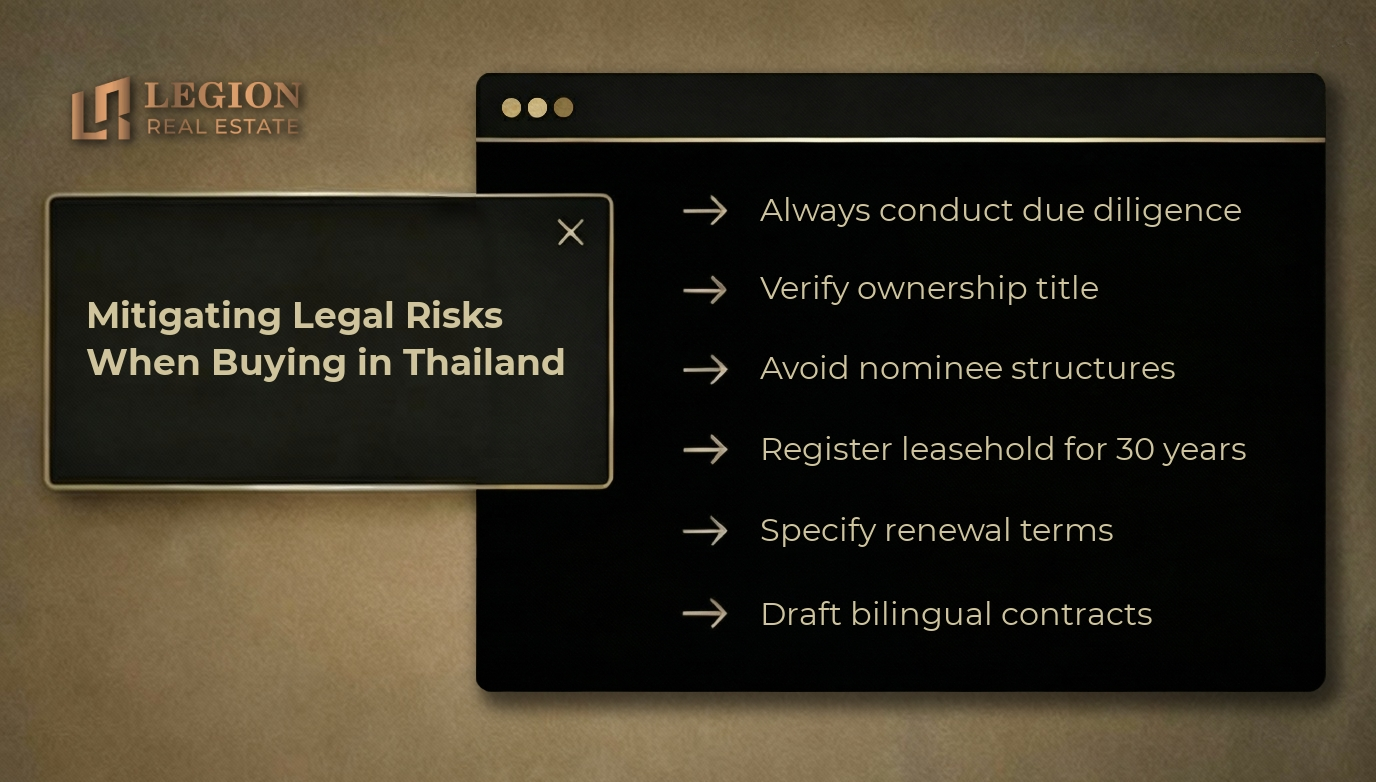
For Russian-speaking investors, there are additional risk factors. Language barriers can lead to misunderstandings of important legal details, so all contracts should be available in Russian or English with professional translation. Bilingual agreements should clearly specify which version prevails in case of discrepancies. It is also important to monitor fund transfers and ensure compliance with the currency regulations of your country of residence.
What an investor should check before making payment:
Working with a professional lawyer who specializes in real estate transactions for foreigners involves additional costs but can prevent much greater losses in the future. A good lawyer will not only conduct legal checks but also help structure the transaction optimally according to your specific circumstances and goals. You can learn more about the most common legal risks when purchasing property.
Buying property in Thailand requires a systematic approach, especially for foreign investors. A properly structured decision-making process will help avoid many problems and maximize the value of your investment.
A clear property selection algorithm begins with defining your investment goals. You should clearly understand why you are purchasing property: to generate rental income, create a second residence for holidays, protect capital from inflation, or combine several of these goals. Each goal implies different priorities when choosing both the property type and the ownership structure.
Follow this step-by-step plan to make an informed decision:
Economic analysis is a critical element of the decision-making process. Calculate not only the initial acquisition costs but also all related expenses: purchase taxes, annual property taxes, management company fees, insurance, maintenance, and repairs. On the income side, estimate realistic occupancy rates and rental prices across different seasons, taking into account agency commissions and taxes on rental income.
Do not forget about the exit strategy: how the property value may change over time, the liquidity on the secondary market, and the taxes associated with selling the property. This is especially important for leasehold, whose value decreases as the lease term approaches its end.
Carefully following this algorithm will increase the chances of a successful and profitable investment in Thai real estate while minimizing legal and financial risks.
Investors with experience in the Bali property market often notice many similarities when entering the Thai market. Both popular Asian destinations have comparable mechanisms for protecting the domestic real estate market and restricting foreign buyers, creating opportunities to apply previously gained experience.
In both countries, foreigners face similar challenges: restrictions on direct land ownership, the need to structure deals through long-term leases or corporate mechanisms, and the importance of legal expertise and thorough due diligence. As in Thailand, foreign investors in Bali often rely on long-term ownership structures and complex legal arrangements to gain control over property.
Experience in the Bali market teaches investors several critical principles that are equally applicable in Thailand. First of all, it highlights the importance of carefully verifying the legal status of both the property and the land. In Bali, as in Thailand, there are different land categories with different legal regimes, and misunderstanding these details can lead to serious problems.
Another important lesson is the critical role of reliable partners such as lawyers, agents, and property management companies. In both countries, the quality of these partners often determines the success or failure of an investment. Legion Real Estate, which specializes in the Bali market, follows this approach by helping clients structure transactions safely and select properties with clear rental models and reliable management.
The third principle concerns return calculations. Experienced investors know that all expenses must be considered, including local taxes, fees, management costs, and maintenance. In both Bali and Thailand, beginners often underestimate these costs, which can lead to disappointment with the actual investment returns.
Finally, experience in Bali highlights the importance of understanding local tourism dynamics, seasonality, and tenant preferences. These insights can be easily applied to the Thai market, especially in resort locations such as Phuket or Samui, where similar tourism patterns exist.
When choosing between ownership structures, it is important to note that leasehold in Bali shares many similarities with leasehold in Thailand, especially in terms of contract structures and renewal risks. Investors who have worked with leasehold properties in Bali often better understand the nuances and potential pitfalls of leasehold contracts in Thailand.
By applying experience gained in Bali, investors can navigate the legal complexities of the Thai real estate market more confidently, assess potential returns more accurately, and manage risks more effectively. This cross-market experience becomes especially valuable when many Russian-speaking investors seek diversification opportunities across different Asian countries. For a better understanding of these approaches, you can explore the section on investment recommendations in Bali.
Choosing between freehold and leasehold in Thailand is a strategic decision that should align with your investment goals and planning horizon. Let us summarize the key points to consider when making this important decision.
These key principles will help you make an informed decision and structure your investment in Thai real estate so that it aligns with your financial goals and provides the necessary level of legal protection.
Conclusion: How to Approach Real Estate Investment in Thailand Without Illusions and With a Focus on Results
Choosing between freehold and leasehold in Thailand is not a formality but a strategic decision that directly affects risk management, ownership duration, and the overall return on your investment. For most private investors, three aspects are critical: legal certainty of ownership rights, transparency and clarity of the tax burden, and the liquidity of the property when exiting the investment.
Asian real estate markets, including Thailand and Bali, require a more careful approach to deal structuring than many European jurisdictions. Local laws are primarily designed to protect the interests of citizens of the country, and foreign investors must adapt to these realities. Without local expertise, it is easy to overlook risks such as leasehold renewal issues or changes in regulations regarding foreign ownership quotas.
The key to success is careful comparison of projects while considering all legal nuances, consulting independent experts, and working with agencies that have real experience structuring transactions in the local market. This is exactly the approach used by Legion Real Estate in Bali, helping clients create legally protected investments with a clear economic model. Apply the same systematic approach when analyzing opportunities in Thailand, and your investments will become not only a source of income but also a reliable long-term asset.

.webp)


