
Thailand has long attracted the attention of English-speaking investors seeking opportunities for passive income and asset diversification in Asia. The stable tourist flow, which in 2025 is expected to reach about 33 million visitors, creates a constant demand for short-term rentals in popular locations: Bangkok, Phuket, and Pattaya. Additionally, the entry threshold for Thailand real estate investment is relatively low, allowing investors to earn income in foreign currency even with moderate investments.
However, there are serious nuances to consider. The legal regime for foreign property ownership in Thailand differs significantly from familiar European norms. The main difference concerns property rights for land and buildings, where restrictions apply to non-residents, and ownership options are divided into freehold (full ownership) and leasehold (long-term lease). These peculiarities require professional legal support and thorough property verification before purchase.
In this article, we'll examine all aspects of investing in real estate in Thailand: from ownership formats and profitability to taxes and risks of buying property in Thailand.
You'll also see a comparison with other popular markets in the region, including Bali, to make an informed decision about whether Thailand suits you as an investment destination for investing in foreign real estate.
Thailand's investment market shows steady recovery after the pandemic. The country remains a key destination for tourists worldwide, supporting demand for property rentals. Bangkok is strengthening its position as Southeast Asia's business hub, attracting corporations and expats who need long-term accommodation. Meanwhile, resort areas, especially Phuket and Pattaya, function as real "rental factories," serving short-term tourists and those who choose Thailand for extended stays.
Thailand real estate investment offers diverse opportunities in the market that allow investors to choose assets according to their goals and budget, and to evaluate in advance the pros and cons of each property format in Thailand.
Urban condominiums in Bangkok attract those oriented toward stable income from long-term rentals to corporate clients. Resort apartments and pool villas in Phuket are suitable for short-term rentals with potentially higher but less stable returns. Between these extremes are townhouses, which can offer a balance between entry cost and profitability.
Regarding financial indicators, gross rental yields vary depending on property type and location. Urban condominiums in Bangkok typically yield 4-6% annually with long-term rentals, while resort properties can show 6-9% with successful short-term rental management, albeit with higher volatility due to seasonality.
Depending on investor goals, different strategies can be chosen. Here are the most popular property types:
The choice between capitalization (value growth) and cash flow (rental income) also affects the investor's decision. Many combine these approaches, acquiring a villa or apartment for personal use during the low season and renting it out during high season. Such lifestyle investments are becoming increasingly popular among English-speaking buyers interested in real estate investment in Thailand for foreigners.
.webp)
One of the main features of investing in Thai real estate is the specific legal regime for foreigners, which is important to understand if you're exploring how to buy property in Thailand without legal risks.
The basic principle of local legislation is simple: foreign citizens cannot own land but can have full ownership of apartments and buildings. This creates a fundamental division between condominiums, where full ownership is possible, and land-based properties (villas, houses) where other legal structures apply.
For condominiums, there is a so-called "foreign quota," according to which no more than 49% of the total building area can belong to foreign citizens. Therefore, when choosing a property, it's critical to check the availability of free quota, as it may already be used up in popular projects. In such cases, developers sometimes offer registration through Thai citizens or companies, which carries serious legal risks.
The key document when buying any real estate in Thailand is the Chanote — the main title document confirming ownership rights. Verifying its authenticity and absence of encumbrances is a mandatory step in any transaction. The Land Office maintains a centralized registry, which simplifies title verification but does not eliminate the need for professional legal support.
It's important to understand that real estate investment in Thailand for foreigners requires strict compliance with the law, and attempts to circumvent the land ownership ban through fictitious schemes can lead to serious problems.
Thai courts focus not so much on the letter as on the "spirit" of the law. Schemes with nominee Thai shareholders, "gray" companies without real activities, or non-standard contracts with guaranteed leases for 90-120 years are often invalidated during legal verification or dispute resolution.
Legal options investing in thailand for foreigners remain: acquiring a condominium in freehold (subject to quota), registering land or a villa for long-term lease (leasehold), structuring through a Thai company with a real business (where a foreigner can own up to 49% of shares), or using an offshore company to own a condominium. Each of these options has its nuances, expenses, and degree of protection, requiring an individual approach to structuring thailand real estate investment.
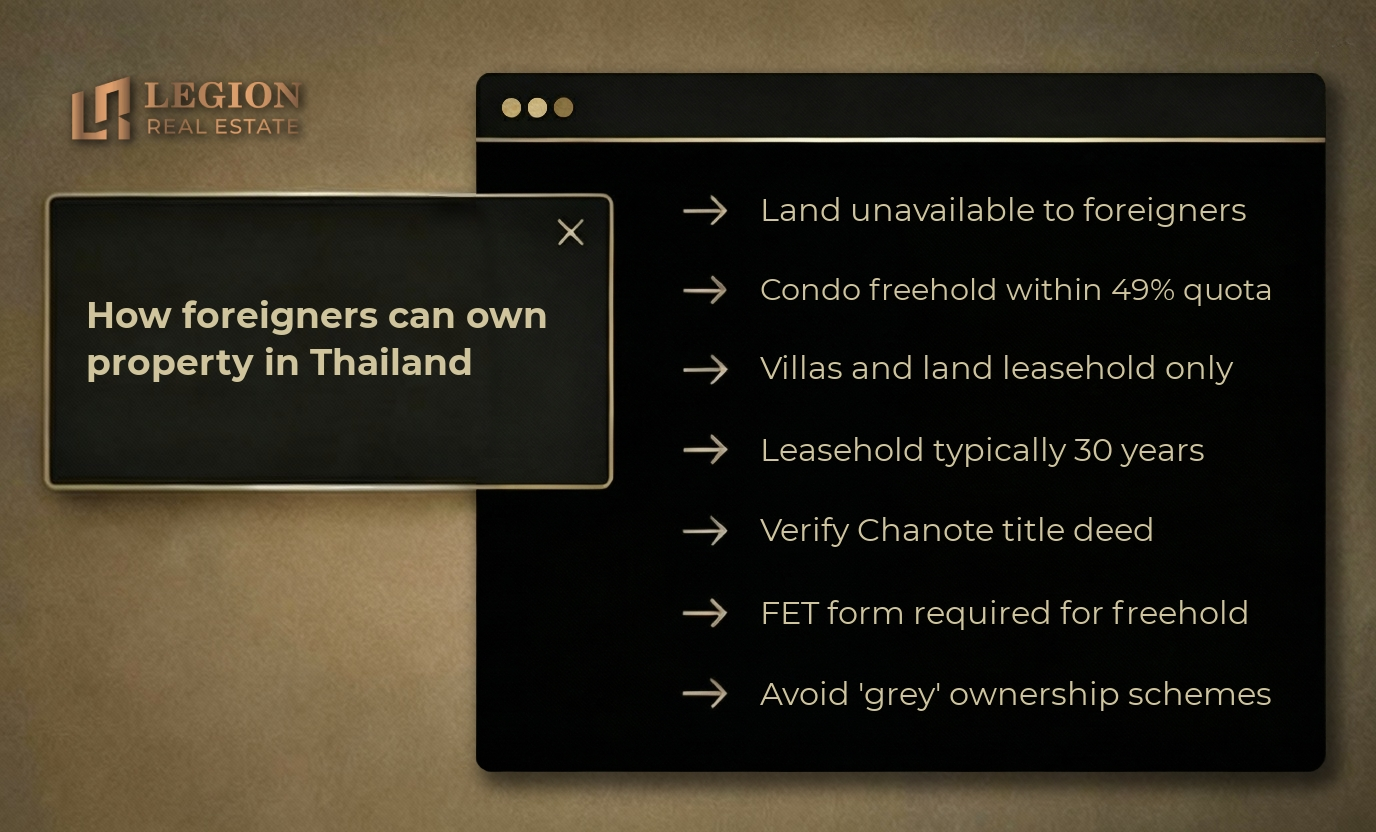
Freehold represents full ownership rights without time limitation, available to foreigners only when purchasing condominiums within the foreign quota. It's important to learn about the nuances and advantages of freehold in advance, as this ownership format provides maximum protection for investor interests. It requires strict currency control compliance: funds must be transferred from abroad in foreign currency, and the bank must issue a special Foreign Exchange Transaction Form (FETF) confirming the transfer.
Leasehold, on the other hand, represents a long-term lease, typically for 30 years with the possibility of extension for two additional 30-year periods (although automatic renewal is not guaranteed by law). This format applies to all property types, including villas and land, and often costs 30-40% less than a similar freehold property. Leasehold doesn't require mandatory transfer of funds from abroad, making the purchase process more flexible.
From a financial perspective, leasehold can be viewed as prepaid rent at current rates. This protects against rental rate inflation and allows entry into premium locations for less money, but limits the ownership horizon and may reduce liquidity upon resale, especially as the lease term approaches its end.
Freehold advantages:
Leasehold advantages:
The choice between freehold and leasehold depends on investment goals, budget, and planning horizon. For those considering real estate as a long-term investment with the prospect of passing it to heirs, freehold is preferable. If the goal is to maximize returns in the medium term (10-15 years) with a limited budget, leasehold may be a more profitable solution. Additionally, for investors looking to create a diversified portfolio, a combination of these formats often proves to be the optimal strategy for thailand property real estate investments.
Investment real estate Thailand offers diverse strategies adapted to different goals and risk profiles. Bangkok, as the economic capital and metropolis, attracts investors focused on stable income from long-term rentals. The city generates steady demand from office workers, expats, and students, ensuring occupancy rates of 80-95% throughout the year. Returns here typically range from 4-6% annually, which is slightly lower than resort locations but offers greater predictability.
Bangkok condominiums in areas with good transportation accessibility (near BTS Skytrain or MRT stations) remain liquid even during economic downturns. Entry budgets range from $70-80 thousand for a compact studio to $150-200 thousand for spacious apartments in modern complexes. Proximity to business centers, universities, and hospitals, which generate constant rental demand, becomes an important factor.
Resort destinations such as Phuket, Pattaya, and Samui offer a different investment model. Here, the main focus is on short-term tourist rentals, potentially yielding higher returns (7-10% annually), but with more pronounced seasonality. Management of such properties is usually transferred to specialized companies that handle marketing, booking, and maintenance for a commission of 15-30% of revenue.
Chiang Mai and other regional centers form a new investment direction oriented toward the growing segment of digital nomads and creative professionals. These cities offer a lower entry threshold (from $50-60 thousand for a modern apartment) with returns comparable to Bangkok. The growing popularity of remote work creates a stable market for medium-term rentals (3-6 months), attractive to investors with limited budgets.
При выборе формата инвестиций важно учитывать не только локацию, но и стадию проекта. Покупка на этапе строительства (off-plan) обычно дает скидку в 15-25% от финальной цены, но несет риски задержки строительства или изменения качества. Готовые объекты стоят дороже, но позволяют немедленно начать получать доход и лучше оценить реальное состояние недвижимости.
When choosing an investment format, it's important to consider not only location but also project stage. Buying at the construction stage (off-plan) usually gives a discount of 15-25% from the final price but carries risks of construction delays or quality changes. Completed properties cost more but allow immediate income generation and better assessment of the property's actual condition.
Typical investment scenarios in Thailand include:
Each of these scenarios has its risks and return potential, making the Thai market suitable for different types of investors — from conservative to those seeking high returns with manageable risks. Check out the selection of properties in Thailand, to find an investment that matches your goals. The next step is understanding the practical process of buying and structuring such investments.
Acquiring property in Thailand is a process requiring a systematic approach and attention to detail, especially if you're considering the object as an investment. Before starting the search, it's necessary to clearly define investment goals, budget, and preferred ownership format (freehold or leasehold). At this stage, it's worth conducting preliminary profitability calculations using real data on rental rates, not developers' marketing promises.
After selecting a suitable property, an investor typically follows this path:
After completing the legal formalities, the investor can either engage in self-management of the property or transfer it to a specialized management company for rental. Choosing a management company is a separate important stage requiring verification of reputation, experience in the specific location, and transparency of commission structure.
The entire process from property selection to key handover usually takes 1 to 3 months for completed properties and can extend to a year or more for projects under construction. Properly structuring each stage will help avoid typical mistakes and maximize investment protection when investing in thailand real estate.
The investment attractiveness of real estate in Thailand is often assessed by gross yield indicators, which can look quite tempting in marketing materials. However, for a realistic assessment, it's necessary to account for all taxes and expenses that significantly reduce the final profit. Typical gross yields range from 4-6% for long-term rental of condominiums in Bangkok to 7-10% for short-term rental of resort properties in Phuket or Pattaya.
When transitioning from gross to net yield, several categories of expenses and taxes must be considered. First, these are taxes and fees during purchase. They differ for freehold and leasehold but average 3-6.3% of the property value. Standard practice assumes that the transfer fee (2%) is split between seller and buyer; however, this is subject to negotiation and may vary depending on the specific deal conditions.
During property ownership, the investor must pay an annual property tax, which for a medium-value property amounts to about 0.02-0.1% of the assessed value. More significant is the tax on rental income, which for non-residents staying in Thailand less than 180 days per year is a fixed 15%. Residents can choose a progressive tax scale (0-35%), which can be advantageous with low overall income.
When selling property, either a Specific Business Tax (SBT) of 3.3% of the sale price (if the property was owned for less than 5 years) or a Stamp Duty of 0.5% is charged if the ownership period exceeds 5 years. Additionally, a withholding tax is retained from the seller, calculated by a complex formula considering the ownership period, but typically amounting to 5-15% of the profit.
Besides taxes, there are ongoing operational expenses:
Considering all these factors, the real net yield is usually 2-4 percentage points lower than gross indicators. For example, a condominium with a stated gross yield of 6% may bring about 3-4% net profit after accounting for all expenses. For an objective assessment of investment attractiveness, it's necessary to create a detailed financial plan that includes all these components and accounts for potential vacancy periods between tenants. Learn more about approaches to long-term real estate investments from industry experts.
.webp)
When investing in Thailand real estate, as in any foreign market, there are specific risks that need to be considered and minimized. Understanding these risks is key to creating a sustainable investment strategy that will work even in adverse scenarios.
To learn more about main investment risks and mitigation methods, it's recommended to consult experienced advisors. Proper management of these risks requires a comprehensive approach: working with professional lawyers and consultants, thorough verification of all transaction aspects, and creating a financial model with various scenarios. Investments in Thailand real estate can be quite profitable, but only with a balanced approach and understanding of local market specifics, especially the risks of buying property in Thailand.
When investing in Southeast Asian real estate, many investors consider both Thailand and Bali (Indonesia). These popular destinations have their peculiarities, which are important to consider when building an investment strategy. Comparing these markets will help understand which one better corresponds to your goals and preferences for investing in foreign real estate.
The legal regime for property ownership differs significantly. In Thailand, foreigners can purchase condominiums in full ownership (freehold) within the 49% quota, while for land and villas only leasehold is available. In Bali, the main format for foreigners is long-term lease (leasehold), usually structured for 25-30 years with possibility of extension. In both cases, legal support is critically important, but in Bali, deeper expertise in local law is often required due to the peculiarities of the Indonesian legal system.
Tourist flows and seasonality also differ. Thailand attracts more mass and diverse tourism, with relatively even distribution across seasons (especially in Bangkok). Bali in recent years has been strengthening its position in the premium segment and among wellness tourism enthusiasts, with a more pronounced high season. This difference affects rental business strategies and income predictability.
Regarding investment formats, Thailand offers a more diverse selection: from urban condominiums to resort villas. The market is more mature, with a larger number of secondary offerings. Bali is more oriented toward villas and boutique projects emphasizing design and location uniqueness. Many properties in Bali are created with a focus on premium rentals and individualized management approaches.
A diversification strategy between these markets can be particularly effective for investors seeking to reduce risks and expand their portfolio. For example, a condominium in Bangkok can provide stable base income from long-term rentals, while a villa in Bali will be oriented toward higher, though less predictable income from premium tourists.
Legion Real Estate, specializing in the Bali market, helps investors develop a strategy considering the peculiarities of both destinations. See our guide to investments in Bali for more details: the company's experience allows comparing investment opportunities in different Southeast Asian countries and choosing optimal solutions considering each client's risk profile and goals.
If the concept of investing in Southeast Asian resort real estate appeals to you, but you prefer to work in a more familiar model, Bali can be a logical alternative or complement to investments in Thailand. Many investors choose Bali precisely because of its focus on the premium segment, growing popularity among digital nomads, and special atmosphere that attracts a more affluent audience willing to pay for a unique experience.
Legion Real Estate specializes in the Bali market, offering comprehensive support to English-speaking investors. The company helps with selecting various property types — from ready villas and apartments to land plots for development. Each project undergoes thorough legal and financial verification and is analyzed in terms of potential returns and capital growth.
Particularly valuable for English-speaking investors is the opportunity to work with a team that speaks their language while possessing a deep understanding of the local market and proven relationships with developers. Legion Real Estate works directly with reliable developers, allowing clients to avoid paying commissions — these are already included in the property price and paid by the seller.
If you're considering investments in this region, the Legion Real Estate team is ready to discuss your individual strategy, taking into account experience in Bali as well as general understanding of Southeast Asian markets, including Thailand. Such a comprehensive approach helps not only choose the right property but also structure the investment in the most profitable and secure way, whether you're interested in thailand real estate investment law revisions or thailand real estate investment visa opportunities.
Investing in real estate in Thailand can be an attractive way to diversify assets and generate passive income, but it requires a balanced approach and understanding of local specifics. Here are the key points to help you make an informed decision:
Real estate in Thailand can become an attractive instrument for creating passive income and preserving capital, but only with the right choice of strategy and legally clean ownership structure. The key to success is a realistic approach to assessing profitability: it's necessary to account for all taxes, management expenses, possible vacancies, and seasonal demand fluctuations. The investor should clearly understand their investment horizon and have a well-thought-out exit plan, whether it's property resale or transfer to heirs.
It's important to avoid blindly copying others' experiences or trusting "guaranteed" schemes, which often turn out to be marketing exaggerations. Instead, one should rely on thorough due diligence, work with licensed agencies and specialized lawyers who will help structure the deal according to your goals and acceptable risk level. Remember that the most attractive-looking offers often hide legal or financial traps.
A reasonable approach also involves comparing Thailand with other regional markets, including Bali, and possible diversification of investments across several locations. Such a strategy helps reduce country and regulatory risks while utilizing the advantages of different markets. In this context, professional consultations from specialists such as Legion Real Estate can be a valuable resource, helping navigate the complexities of the Southeast Asian investment landscape, including real estate investment trust thailand options and thailand prime property freehold and leasehold real estate investment trust opportunities, and make informed decisions about foreign investment in thailand real estate that will work for you for many years.
A foreigner can become a full owner (freehold) only of a condominium, provided that the total area of condominiums owned by foreigners does not exceed 49% of the building's total residential area. Land and detached houses are available only through long-term lease (leasehold) or complex corporate structures.
To obtain an investment visa (Thailand Elite), you need to pay from 600,000 baht (about $17,000) for a 5-year program to 2,140,000 baht (about $60,000) for 20 years. This is not a full-fledged residence permit but rather a long-term visa with multiple entries. A full residence permit requires larger investments from $300,000 in Thai business or government bonds.
In freehold format (full ownership), a foreigner can buy only a condominium forever, within the 49% quota. For land and houses, only leasehold is available (usually for 30 years with extension options), which is not a perpetual right.
Buying a condo in Thailand can be a profitable investment with the right choice of location, thorough legal verification, and understanding of all risks. For many foreign investors wondering "is buying a condo in thailand a good investment," the answer depends on their specific goals, budget, and risk tolerance, but generally, condominiums offer a more straightforward legal structure than buying a house.

.webp)


