
Phuket has become one of the key destinations for real estate investment in Southeast Asia, and this is not surprising. The largest island of Thailand offers a unique combination of advantages: year-round tourist demand, well-developed infrastructure, and a stable flow of tenants from Ukraine, Europe, and Asia. All this makes it an attractive alternative to traditional investment markets.
For investors, real estate in Phuket is of particular interest as a way to diversify capital outside their home country. A relatively low entry threshold (from 3 million baht for a modest apartment), the possibility of earning income in dollars or euros from rentals, and strong prospects for capital appreciation all form a compelling investment proposition. In this article, you will learn which areas of the island are the most перспективные, which property types are available to foreigners, and how to properly structure a deal. We will also examine how property prices in Phuket are formed, what affects pricing across locations, and how to calculate real investment returns considering taxes and operating costs.
The Phuket real estate market has shown steady growth in recent years even against the backdrop of a general slowdown in the Thai economy. While the mainland Thailand market shows declining sales in certain segments, Phuket continues to attract foreign buyers thanks to its status as an international resort and a stable tourist flow.
At the same time, affordable real estate in Phuket still exists in certain areas and at early construction stages, but the liquidity and growth potential of such properties require separate evaluation. The main pool of investors consists of Ukrainians, Europeans (Scandinavians, British, Germans), Chinese buyers, as well as residents of Singapore and Hong Kong.
Condominiums remain the most in-demand property type as they are the only format foreigners can purchase directly in full ownership. They are followed by villas and hotel-style apartments offering guaranteed income. In premium locations, property prices in Phuket show stable growth of 8–12% per year, while in more mass-market segments this figure is lower at around 5–7%. A key trend in recent years is the increase in buyers purchasing property not only for investment but also for personal residence.
It is important to understand the main trends shaping the market:
Choosing the right area is one of the key factors for a successful investment in Phuket. Each location has its own unique characteristics that directly affect potential returns, resale liquidity, and quality of life if you plan to use the property personally.
Before diving into specific locations, it is important to understand how your investment goals define the ideal area for you. If your goal is maximum short-term rental yield, you should consider popular tourist zones with good access to beaches and entertainment. If you are focused on long-term capital growth, attention should be paid to developing areas with planned infrastructure projects and limited land supply.
For those planning to live in Phuket part of the year, key factors include comfort, access to healthcare, international schools, and a calm and safe environment. Transport accessibility is also important, as proximity to the airport can save hours on each trip.
The west coast of Phuket is traditionally considered a premium investment zone. It is home to the island’s best beaches and the main concentration of tourist activity. Bang Tao and Laguna remain the most prestigious areas, featuring luxury developments, five-star hotels, and high-end villas.
In these locations, Phuket real estate demonstrates the highest rental rates and stable demand from affluent tourists and expats, which positively affects property profitability.
Kamala and Surin also belong to the premium segment, offering a balance between proximity to entertainment and relative tranquility. Here you can find both luxury hillside villas with panoramic sea views and modern condominiums with developed infrastructure. Occupancy rates in these areas during high season reach 80–90%.
Patong is the center of nightlife and entertainment, attracting tourists who stay for short periods and are willing to pay higher rental prices. Properties here can generate maximum short-term income, but often at the cost of higher wear and a less спокойная environment.
The east coast and southern part of Phuket offer a more спокойная atmosphere and often more affordable property prices. Rawai and Nai Harn in the south are popular among families and long-term expats. Long-term rentals dominate here, providing more stable but lower income.
The east coast, including Koh Kaew and Cape Yamu, offers beautiful views of Phang Nga Bay and surrounding islands. These areas are only beginning to develop as investment destinations but have strong potential due to limited land supply and new infrastructure projects.
For investors focused on long-term capital appreciation, developing areas in Phuket are of particular interest. Mai Khao in the north of the island, near the airport, is becoming increasingly popular due to the construction of new medical and educational facilities. A branch of the prestigious Bumrungrad International Hospital is planned here, which could significantly increase the area’s attractiveness for medical tourists and retirees.
Phuket Town also shows interesting potential as the historical center of the island undergoing gradual gentrification. Old Sino-Portuguese buildings are being transformed into stylish boutique hotels, restaurants, and art spaces, attracting a new type of tourist and tenant.

Understanding different property types in Phuket and their characteristics is critical for making informed investment decisions. Each format, from studios to luxury villas, has its own income model, risk level, and management requirements.
Luxury real estate in Phuket requires separate analysis, as this segment targets a narrower audience, involves higher entry budgets, and is highly sensitive to location quality and service level.
Condominiums are the most popular and accessible investment format for foreigners in Phuket. The main advantage is the ability to purchase in full ownership (freehold), which provides maximum legal protection and liquidity upon resale. Entry prices range from around 3 million baht for a studio in developing areas to 15–20 million baht for premium seafront apartments. Condos typically offer full management and maintenance services, including pools, fitness centers, and security, simplifying rental operations with minimal owner involvement.
Villas and houses belong to a higher price segment, starting from approximately 10 million baht for basic options and reaching hundreds of millions for sea-view residences. Compared to condominiums, this format can generate higher absolute rental income but requires significantly higher maintenance and management costs.
It is important to note that villa ownership in Phuket has legal specifics, as foreigners cannot directly own land in Thailand. Purchases are usually structured through long-term land lease (leasehold) or via a Thai company in compliance with local regulations.
Hotel apartments and condo-hotels with guaranteed income are becoming increasingly popular in Phuket. These properties offer fixed returns, typically 5–8% annually, for a defined period of 3–5 years. This is a convenient solution for investors who do not want to manage rentals themselves. However, it is essential to carefully analyze the financial model and operator reputation to assess the sustainability of returns after the guarantee period ends.
Commercial real estate in Phuket also deserves attention. The highest demand is for small retail units in tourist areas, office spaces, and mini-hotels. Commercial properties often offer higher yields but require larger initial capital and a deeper understanding of the local business environment.
Land plots represent a more complex investment instrument requiring deep understanding of local zoning and construction regulations. Foreigners cannot directly own land, which creates additional legal complexity. However, with the right approach and long-term horizon, land can provide significant capital appreciation, especially in areas with developing infrastructure.
Legal aspects of property ownership in Phuket are perhaps the most important topic for foreign investors. Thai legislation includes several significant restrictions that must be clearly understood before making a purchase to avoid future legal issues.
The fundamental principle of Thai property law is that foreigners cannot directly own land in Thailand. This key restriction affects deal structures and available ownership formats. Attempts to bypass this rule through nominees or unofficial schemes may result in loss of investment and legal penalties.
At the same time, Thai law provides several legal mechanisms for foreign property ownership. Understanding these options allows structuring a deal in the safest possible way from a legal perspective.
Main ownership structures available to foreigners in Phuket
Legion Real Estate, in its primary market Bali, applies a multi-level legal due diligence process including title verification, developer checks, legal risk assessment, and deal structuring. The same principles are critically important for Phuket investors. Purchasing property through professional intermediaries provides an additional layer of protection against potential legal issues.
The process of purchasing real estate in Phuket has its own specifics, and understanding all stages helps avoid common mistakes and stress.
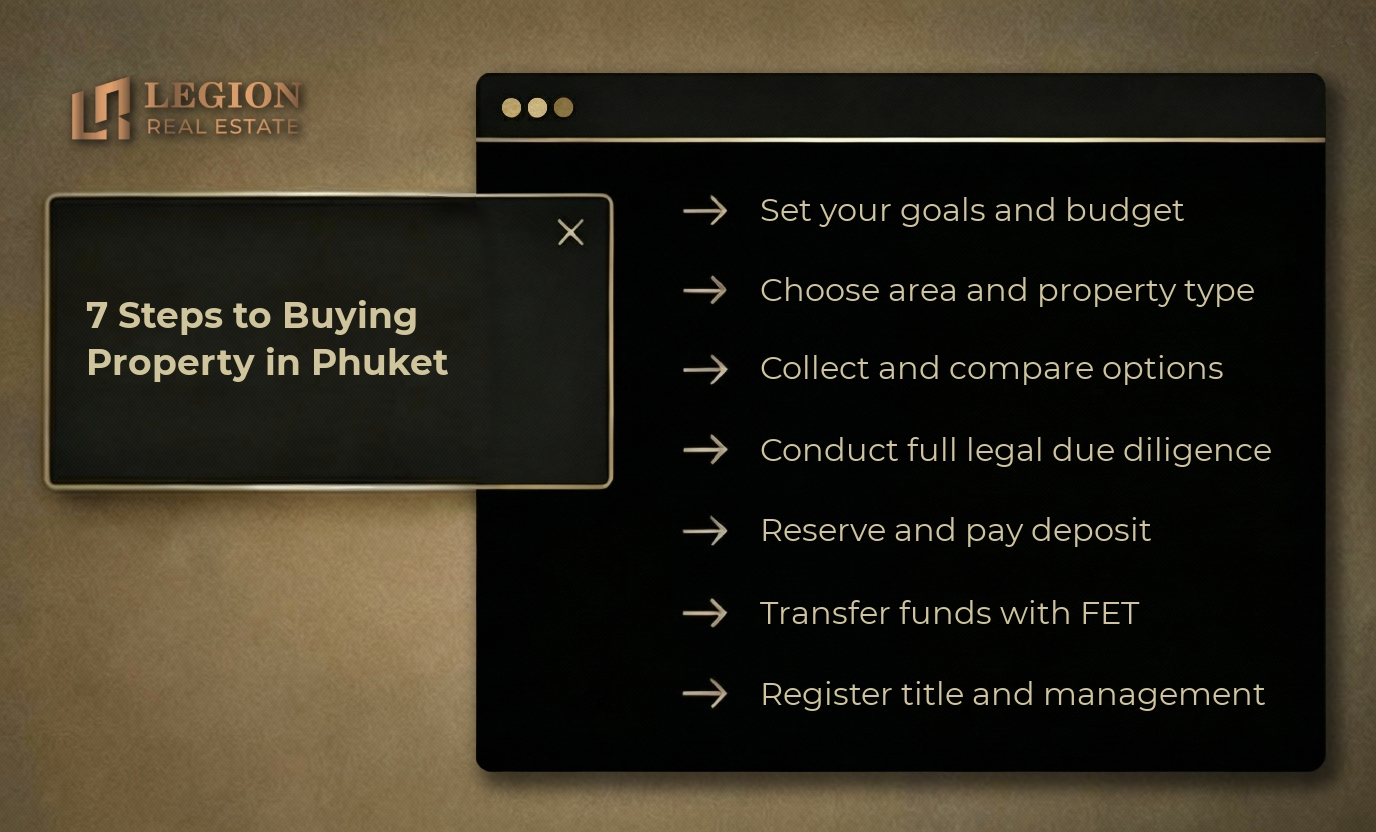
A realistic assessment of financial prospects is the foundation of rational investment decisions in Phuket. Too often, investors rely on optimistic projections from developers or agents without conducting their own calculations.
A proper analysis must take into account not only the stated return but also operating expenses, taxes, occupancy rates, seasonality, and property management fees. Only after that can the true investment potential of a property be objectively evaluated.
The starting point is the calculation of potential gross income, meaning the maximum amount a property can generate under ideal occupancy conditions. For short-term rentals, this involves multiplying the average daily rate by 365 days. For example, if the average daily rate for a one-bedroom apartment is 3,000 baht, the potential annual income would be around 1.095 million baht. However, this is a theoretical maximum that must be adjusted based on actual occupancy.
Actual occupancy in Phuket depends heavily on seasonality, location, and management quality. During the high season (November to April), well-located properties can reach 80–90% occupancy, while in the low season this can drop to 30–40%. On average, well-managed properties in prime locations maintain annual occupancy of around 60–70%. As a result, effective annual income is typically 60–70% of the theoretical maximum.
From this income, all operating expenses must be deducted, including the following:
After deducting all operating expenses, you arrive at net operating income, which should then be compared to the initial investment to calculate net yield. For properties in good locations in Phuket, realistic net rental yields are typically 5–8% annually for short-term rentals and 4–6% for long-term rentals. Higher figures (10–15%) are usually either overly optimistic or do not account for all costs.
In addition to rental income, it is important to consider capital appreciation potential. Historically, real estate in prime areas of Phuket has shown growth of around 5–8% per year, which, with the right property selection, can bring total returns to approximately 10–15% annually.
The income potential of properties is clearly demonstrated by the performance of premium locations and top projects on the island. Real estate investments in Phuket are becoming increasingly attractive for those seeking stable income and long-term capital growth. However, it is essential to analyze every aspect of the investment model rather than relying solely on marketing promises.

Investing in overseas real estate always involves risks, especially in markets with a different legal system and business culture. Based on transaction analysis, several of the most common mistakes made by foreign investors in Phuket can be identified.
A lack of understanding of legal restrictions for foreigners is perhaps the most serious mistake. Many investors do not realize that they cannot directly own land in Thailand and end up signing agreements that later prove legally invalid. Some are tempted by questionable nominee structures, which can lead to a complete loss of investment. The solution is to carefully study all legal ownership options and consult an independent lawyer.
The absence of proper legal due diligence is another critical mistake. Investors often neglect checking title ownership, encumbrances, construction permits, and zoning compliance. This can lead to serious problems after purchase, including the inability to legally use the property. The solution is to conduct a full legal audit (due diligence) before buying.
Incorrect structuring of money transfers is a specific issue for foreign buyers of condominiums. Without a properly issued Foreign Exchange Transaction Form (FET), it is impossible to register ownership. The solution is to transfer funds directly from a foreign bank in foreign currency with a clearly stated purpose of “property purchase.”
Overreliance on “guaranteed returns” is another common pitfall. Marketing promises of high guaranteed yields are often unrealistic or temporary. After the guaranteed period ends, investors may face significantly lower returns. The solution is to analyze the financial model and business plan of the project and study the developer’s track record.
Underestimating the total cost of ownership is a frequent mistake. In addition to the purchase price, ownership in Phuket includes taxes, maintenance, insurance, repairs, and upgrades. Ignoring these costs leads to incorrect yield calculations. The solution is to build a detailed budget covering all ownership expenses.
Many investors purchase property without a physical inspection. Remote investments in new developments carry the risk that the actual quality does not match expectations. The solution is to visit the property in person if possible, or arrange an independent inspection and request detailed photos and videos.
Neglecting the quality of property management can significantly affect returns. Even a good property may underperform if poorly managed. The solution is to carefully select a management company, review their experience, feedback, and performance metrics.
Choosing reliable partners — the developer, the specific project, and the management company — directly determines the success of your investment if you consider Phuket real estate as a long-term strategy.
This is especially critical for remote investors who do not control the property personally and depend on transaction transparency, construction quality, and management efficiency. A mistake at the partner selection stage can undermine even a strong location and an initially attractive yield.
The developer’s reputation is the first and possibly most important selection criterion. Ideally, preference should be given to developers with successfully completed projects in Phuket and positive reviews from existing clients. Check the company’s history, how long it has been operating, whether there were delays in project delivery, and how post-handover issues are handled. It is highly recommended to visit previously completed projects to assess build quality and compliance with what was promised.
Legal transparency is critically important when selecting both a developer and a specific project, especially if the property is purchased at the construction stage.
A reliable developer must provide a full package of documents, including proof of land ownership or lease rights, construction permits, environmental approvals, and a detailed sales contract in both Thai and English. It is also necessary to verify all approvals and compliance with zoning regulations.
Real estate in Phuket offered by developers often comes with guaranteed return programs or management packages. These offers should be carefully analyzed in terms of realism and long-term sustainability.
For investors focused on rental income, choosing a management company is just as important as selecting the property itself. Effective management can significantly increase returns, while poor management can eliminate most advantages of even a high-quality asset.
When choosing partners, pay attention to the following key criteria:
Legion Real Estate, in its core market of Bali, applies a multi-stage partner and property verification system, including legal due diligence, construction quality assessment, and business model sustainability analysis. The same principles are equally important for investors in Phuket.
For experienced investors aiming for geographic diversification of their real estate portfolio, combining properties in Phuket with investments in Bali can offer compelling opportunities. Both destinations are leading resort markets in Southeast Asia, but they have important differences that can complement each other within an investment strategy.
Phuket and Bali differ across several key parameters. The real estate market in Phuket is built on a more mature infrastructure and a well-developed ecosystem of services for foreigners, ranging from international schools to specialized medical centers.
Bali, on the other hand, attracts a younger and more dynamic audience focused on surfing, yoga, and digital entrepreneurship. This is reflected in demand structure: Phuket has a higher share of European and Ukrainian tourists, while Bali is more oriented toward Australians and a growing flow of visitors from other Asian countries.
The legal framework for property ownership also differs. In Phuket, foreigners can own condominiums in full ownership (freehold), whereas in Bali the primary structure is long-term lease (leasehold) and the “hak guna bangunan” scheme (right to use a building). At the same time, Indonesian legislation offers more flexible structures for foreign businesses, which can be an advantage for investors planning active participation in the local economy.
Combining investments across both markets allows investors to achieve several strategic goals.
Investments in Phuket real estate, combined with similar allocations in Bali, allow investors to diversify risks and maximize potential returns.
Legion Real Estate, specializing in the Bali market, applies a comprehensive approach to analyzing investment opportunities, including assessment of legal risks, potential returns, and long-term growth prospects. The same approach can be applied to Phuket, ensuring consistency of investment strategy across both markets.
Managing property remotely comes with certain challenges, but with the right approach and modern technologies, these difficulties can be effectively managed. For investors who do not plan to live in Phuket permanently, it is especially important to build a reliable system of remote control and property management.
The process of selecting and evaluating properties online has become much easier thanks to modern technologies. Real-time video tours, 3D models, and high-resolution photos allow you to form a fairly accurate understanding of a property even when you are in another country. However, before making a final decision, it is recommended either to visit the property in person or to hire an independent inspector who can conduct a detailed check and provide an objective report.
For remote transaction execution, all documents must be properly prepared. It is critical to issue a notarized power of attorney to a representative in Thailand (lawyer or agent) who can act on your behalf. This document must be certified at a Thai consulate or apostilled and should clearly define the scope of authority. In some cases, your physical presence or the use of verified electronic signing services may still be required.
Phuket real estate forums and specialized online communities can be a valuable source of practical information and contacts for remote investors. Sharing experiences with other property owners helps avoid many common mistakes.
Special attention should be paid to selecting and monitoring the property management company. It is important to establish a clear reporting system, including regular financial reports, occupancy data, and photo reports on property condition. You should define key performance indicators (KPIs) and regularly evaluate the manager’s performance. Modern technologies allow remote control of many aspects, from smart home systems to online access to security cameras.
For effective remote management, the following practical approaches are recommended:
When making a decision to invest in real estate in Phuket, it is important to define your strategy, investment horizon, and acceptable level of risk in advance.
To summarize the key factors that directly affect the outcome: location selection, legal ownership structure, developer quality, management model, and realistic yield calculations that take all expenses into account.
Phuket is a mature and competitive real estate market where the era of “easy money” and spontaneous successful investments is over. Today, success requires a strategic approach and careful planning. Instead of starting with browsing attractive villas and condominiums, a rational investor first defines clear goals, investment horizon, acceptable risk level, and budget.
Three fundamental principles should guide any decision to buy property in Phuket: selecting the right location and property type in line with investment goals, ensuring full legal transparency of the transaction, and conducting a realistic financial analysis that accounts for all aspects of ownership. Ignoring any of these factors can turn a potentially profitable investment into a problematic asset.
Before investing, it is important to understand not only legal aspects and market specifics, but also cultural factors, climate conditions, and the seasonality of tourist demand, all of which directly affect profitability.
It is worth noting that many investment principles relevant to Phuket also apply to other resort markets in Southeast Asia, including Bali. Experienced investors increasingly build diversified portfolios across multiple locations and property types rather than focusing on a single asset. Legion Real Estate, with deep expertise in the Bali market, can help structure such a strategy and identify the key questions to ask local partners in Phuket. Ultimately, the goal of owning a tropical home or generating stable passive income is achievable with a well-structured, systematic approach and a clear understanding of the local market.
Prices vary significantly depending on the property type and location. Condominiums start from around 3 million baht (approximately $85,000) for a studio in developing areas and can reach 15–20 million baht for premium apartments by the sea. Villas start from around 8–10 million baht for basic options and can go up to hundreds of millions for luxury properties.
Foreigners can purchase condominiums in full ownership (freehold), provided that no more than 49% of the total building area is owned by foreigners. Direct land ownership is not allowed, so for villas the available options are long-term leasehold or ownership through a Thai company.
With the right property selection and proper management, real estate in Phuket can generate around 5–8% net rental yield. Taking into account capital appreciation (on average 5–8% annually in prime areas), total returns can reach 10–15% per year.
The most востребованные types are small commercial spaces in tourist areas, including shops, cafes, beauty salons, and offices for travel companies. Small boutique hotels and guesthouses with 6–12 rooms are also popular.
It is important to understand legal restrictions for foreigners, seasonality of tourist demand, differences between island areas, and taxation specifics. Proper structuring of fund transfers and thorough legal due diligence of the property are critical for a safe investment.

.webp)


