Bali confidently holds its position as one of the leading global resort real estate markets. Growing tourist flows, the rise of digital nomads, and steady investor interest make Bali real estate a logical choice for those seeking income generating assets in Asia.
The realities of life in Bali in 2025–2026 differ significantly from what they were five years ago. Rental and food prices have increased, and living in Bali now requires more conscious financial planning. At the same time, compared to Dubai, Singapore, or European capitals, the island still offers a strong balance between cost and quality of life.
At the same time, the market has clear specifics: rules for foreigners differ from traditional ownership models, leasehold dominates, and projects vary significantly by location, returns, and risk levels.
Legion Real Estate is a licensed real estate agency that helps foreign investors go through all stages of the investment process. From strategy selection and legal support to property management, we provide full cycle support for those who want to buy property in Bali consciously and without unnecessary risks.
In this article, you will get an up to date overview of the Bali market for 2024–2025, understand legal ownership models, explore different locations and property types, and learn how to minimize risks when investing.
Planning to invest in Bali real estate? Here are the key points to consider:
Indonesia’s macroeconomic indicators provide a solid foundation for investing in Bali real estate. The country’s economy shows stable growth, low inflation, and a strong national currency. According to Standard Chartered forecasts, Indonesia’s GDP growth is expected to remain positive in the coming years, creating a favorable environment for long term investments.
Bali’s tourism sector is experiencing a strong recovery after the pandemic. In 2023, the island welcomed around 5 million international tourists, and in 2024 it is expected to surpass pre pandemic levels. It is important to note that tourism in Bali is year round, without strong seasonality, ensuring stable occupancy for rental properties. Key markets include Australia, European countries, and fast growing Asian regions, including China.
Infrastructure development on the island is becoming an additional factor to consider for those looking to buy property in Bali with a focus on capital appreciation.
The government is implementing large scale infrastructure projects, including new roads such as the Gilimanuk–Mengwi highway, as well as modernization of ports and hospitals. Plans also include major theme parks and a second international airport in the north of the island. These developments improve quality of life and increase the investment attractiveness of different areas of Bali.
Indonesia’s government policy is focused on attracting foreign capital through tax incentives and gradual liberalization of rules for non residents. This creates steady rental demand and supports long term price growth for quality properties, which is активно discussed on professional platforms and in Bali real estate communities and forums. Learn more about investing in Bali as a strategic capital allocation in a high potential region.
The Bali real estate market is divided into several clearly defined segments. The lower price range includes affordable housing aimed at locals and long term expats.
The mid segment includes villas and apartments for short and mid term rentals, which is where most foreign investor interest is concentrated. A separate category is luxury real estate in Bali, represented by high end and ultra premium segments with ocean view villas and exclusive residences, typically purchased for personal use by affluent buyers.
After rapid growth in 2021–2023, when prices for some properties increased by 30 to 40 percent, the Bali real estate market is entering a stabilization phase. However, several key trends continue to shape the market:
It is important to understand that real market performance often differs from “hot” investment offers seen on social media. According to Legion Real Estate analytics, stable price growth is around 7 to 10 percent per year in developed areas and can reach 12 to 15 percent in emerging locations with active infrastructure development. When choosing an investment property, it is critical to rely on verified data rather than marketing promises of сверхвысокой returns.

A key feature of investing in Bali real estate is the specific legal framework for foreigners, which must be considered by anyone planning to buy property in Bali.
Unlike many European countries, full ownership rights (Hak Milik, equivalent to freehold) are available only to Indonesian citizens. Foreign investors must use alternative ownership structures, each with its own advantages and limitations.
The most common model for foreigners is Hak Sewa or leasehold, which is a long term land lease and a widely used investment structure in Bali. Typical contracts last 25 to 30 years with an option to extend for another 20 to 25 years. On leased land, an investor can build a property or purchase a completed one, while retaining the right to sell, assign, or inherit the lease. This model is especially suitable for resort investments, as the average payback period is 8 to 12 years, allowing significant returns well before the lease expires.
The second option is Hak Pakai (right of use), which has become more accessible in recent years. Since 2023, foreigners do not need a residence permit (KITAS) to purchase property under Hak Pakai, only a passport and compliance with minimum price thresholds (in Bali, around 5 billion IDR for houses and 2 billion IDR for apartments). Hak Pakai is granted for up to 30 years with extension options and allows both residence and rental use.
For more advanced investments and development projects, the PT PMA + HGB model is used. PT PMA (a foreign owned Indonesian company) can obtain building rights (Hak Guna Bangunan, HGB) for up to 30 years with extensions up to a total of 80 years. This structure is more complex and requires higher minimum capital but offers maximum flexibility for commercial projects.
Regardless of the ownership structure, it is critical to verify:
Legion Real Estate provides full legal due diligence to ensure transaction safety and minimize risks. We strongly do not recommend using nominee ownership schemes, as they carry critical legal risks and may result in a total loss of investment.
The choice of property type is directly linked to your investment strategy and goals. The Bali market offers various real estate formats, each with its own economics and target audience.
Villas are standalone houses with private land and a swimming pool. This format requires a higher entry budget, largely due to land prices in Bali, especially in popular tourist areas.
At the same time, villas are in high demand among families and groups of tourists willing to pay a premium for privacy. They generate a higher average rental rate and perform well in popular locations, but require more active management and maintenance, increasing operational costs.
Apartments and condo hotels offer a lower entry threshold while maintaining attractive returns. Their key advantage is a single operator who handles marketing, guest check-ins, and property management. For investors, this means passive income with minimal involvement. Returns are usually slightly lower than villas but more stable and predictable.
Townhouses and small residential complexes occupy a middle position between villas and apartments. They combine relative privacy with shared infrastructure and often provide a balanced mix of investment cost and potential return.
Land plots and development projects are a more complex but potentially more profitable investment option. By purchasing land and developing it independently, an investor can achieve significant capital growth, but this requires a deep understanding of the local market, regulations, and active project involvement.
An important strategic decision is choosing between a completed property and an off plan purchase. Buying at early construction stages usually provides a 20–30% price advantage but comes with development risks and delayed income. A completed property allows immediate returns but requires a higher entry price.
Legion Real Estate provides access to exclusive projects from verified developers with no commission for the buyer. Our expertise helps you choose the right property for your strategy and ensures professional property management.
Choosing the right area in Bali is one of the key factors for a successful investment. Each location has its own character, target audience, and development potential, which directly affects the property’s profitability and liquidity.
When choosing an area, it is important to align your investment goals with the characteristics of the location. If you aim for maximum short term returns, focus on popular tourist zones. If your priority is long term capital growth, consider emerging areas with strong infrastructure development potential.

When considering real estate in Bali as an investment, it is important to rely on realistic financial metrics, including fractional investment options as an alternative to purchasing a property outright.
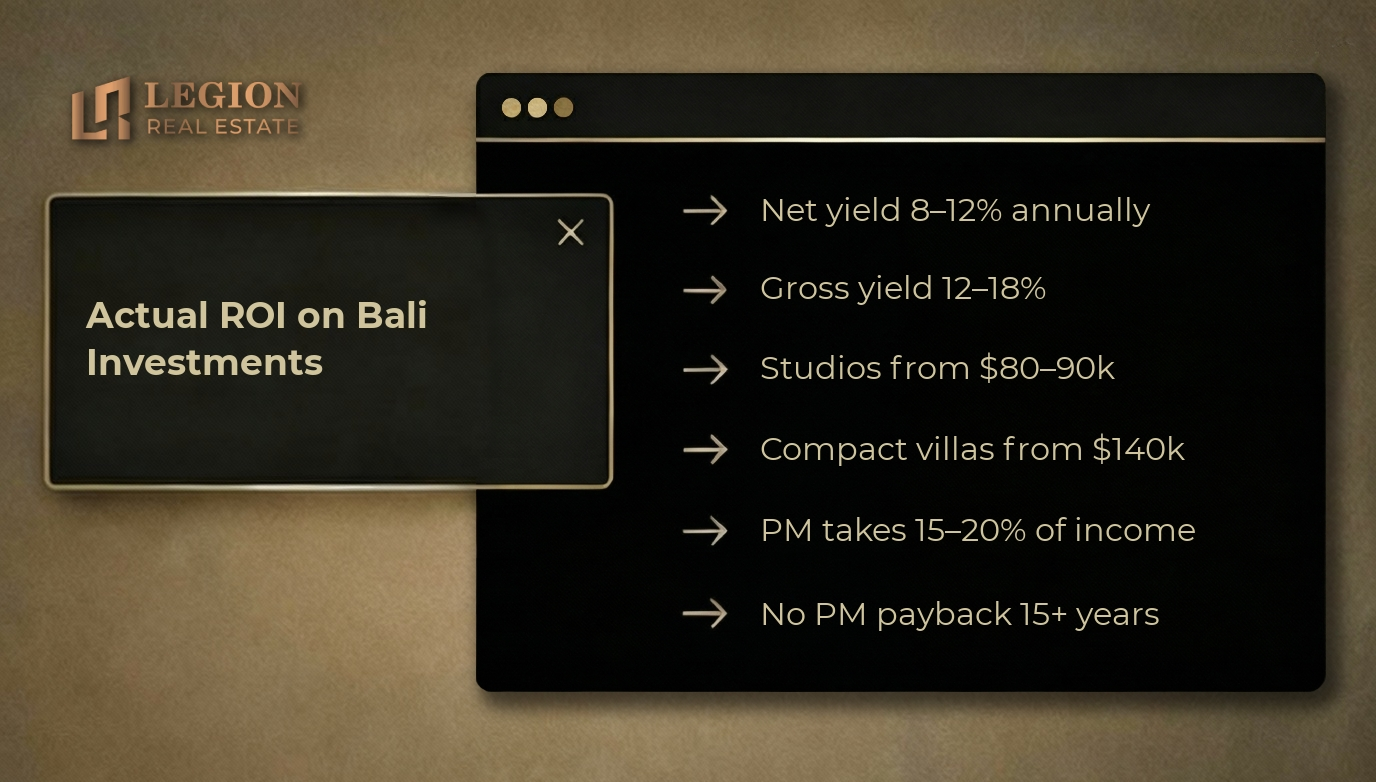
The entry budget varies significantly depending on the property type and location. Studio apartments in promising areas start from $80–90K, one bedroom units from $100–120K, compact villas from $140–160K, while family villas with multiple bedrooms can cost $250K and above.
Returns on Bali real estate under professional management are in a range that compares favorably with most European markets. Gross returns for quality properties in good locations are typically 12–18% annually, while net returns after expenses are around 8–12%, depending on the property type, location, and management efficiency.
When calculating an investment model, the following key expenses should be considered:
Taxation when purchasing property in Bali includes a land acquisition tax (BPHTB, 5%) and stamp duty. The annual property tax (PBB) is about 0.1–0.2% of the assessed value. Rental income tax for non residents is 20% of gross income, though the effective rate can be lower when structured through a company.
For example, consider an investment case: a two bedroom villa in Canggu priced at $180,000 with an average occupancy of 70% can generate a gross annual income of about $25,000–28,000. After all expenses, net annual income would be around $16,000–18,000, resulting in a 9–10% annual return and a theoretical payback period of 10–11 years, excluding capital appreciation. Considering average price growth of quality properties in popular areas (7–10% per year), total returns can reach 15–18% annually.
Investing in Bali real estate with Legion Real Estate is a structured process with clear logic and risk control, especially for those who want to understand in advance how to complete a property transaction without legal mistakes.
Here is what the investor journey looks like from first contact to receiving income:
A key advantage of working with Legion Real Estate is that our services are paid by the seller or developer for the buyer This directly answers the question of whether it is possible to buy property in Bali without hidden fees or increasing the transaction budget
You receive full professional support from property selection to documentation without additional costs on your side Learn more a Legion Real Estate consultation will help you prepare your investment deal
Investing in Bali, like in any emerging market, involves certain risks. However, most of them can be significantly reduced with the right approach and professional support.
Legal risks are the most critical. They include improper land zoning, missing or incomplete building permits, problematic titles, and risky “nominee” ownership schemes. Legion Real Estate conducts multi stage legal due diligence for each property, analyzes the full chain of ownership for land and buildings, verifies compliance with zoning regulations, and ensures the legality of all permits.
Market risks are связані with potential oversupply in certain areas and unrealistic return expectations. We help mitigate these risks by providing objective analysis for each location, realistic occupancy and return forecasts based on current Bali real estate data rather than marketing promises.
Developer risks are especially relevant when buying off plan properties ranging from delays to changes in project concept or even project suspension. Legion Real Estate works only with verified developers with a proven track record. We structure deals with staged payments tied to actual construction progress and include protective clauses for investors.
Operational risks arise during the usage phase and include poor management, downtime, low service quality, negative reviews, and reduced demand. We work only with proven property management companies and ensure regular performance monitoring, timely issue resolution, and transparent reporting.
Currency and liquidity risks relate to potential challenges when exiting the asset and the impact of exchange rate fluctuations on real returns. We help minimize these risks through proper deal structuring, selecting liquid properties in high demand locations, and planning an exit strategy from the purchase stage.
Professional support from Legion Real Estate not only reduces these risks but also adds value through access to exclusive opportunities, tax optimization, and maximizing returns at every stage of the investment lifecycle.
Bali real estate investments are not suitable for everyone and are aimed at investors with different goals and expectations. To understand how much property in Bali will cost in your specific case, it is important to first define your investment profile and acceptable level of risk.
This approach helps you make a well balanced decision and choose a strategy that fits your budget and long term goals.
Legion Real Estate does not offer one size fits all solutions. We help tailor investment formats to your specific risk profile, budget, and goals. Our approach is based on a deep understanding of your priorities and long term support rather than selling specific properties. Bali is not for every investor, but for the right profile it can become one of the most effective parts of an investment portfolio.
Bali is a mature yet still growing real estate market supported by a strong tourism sector and active infrastructure development. For foreign investors, success depends on choosing the right location, the optimal legal ownership structure, and a reliable management partner, especially when evaluating long term investment rather than focusing on the lowest entry price.
Instead of chasing unrealistic high return promises, it is more разумно to plan for stable 8–12% annual returns in foreign currency with professional management and strict legal compliance. In practice, a long term strategy with proper legal structuring and quality management delivers more устойчивые results than trying to cut costs on support or engaging in risky schemes.
Legion Real Estate offers a full support cycle from analyzing investment goals and selecting the right property to structuring the deal legally and organizing professional management. The buyer does not pay for these services, as they are covered by the seller or developer, making the cooperation cost efficient.
Foreigners cannot own land under freehold title (Hak Milik). There are three legal options: leasehold (long term lease for 25–30 years with extension), Hak Pakai (right of use) if price thresholds are met, or ownership through a local PT PMA company. Nominee ownership schemes are highly risky and not recommended.
It depends on your goals. Bali is an attractive destination for earning passive income in foreign currency (8–12% annually), diversifying a portfolio, or combining investment with personal use. However, it requires a careful approach to property selection, legal structure, and management partner.
Studio apartments start from $80–90k, one bedroom apartments from $100–120k, compact villas from $140–160k, and family villas with multiple bedrooms from $250k and above depending on location and quality.
Yes, it is possible with a modest lifestyle. Basic expenses such as renting a studio or apartment outside tourist areas, food, transport, and utilities can fit within this budget. However, for comfortable living in a good area with regular leisure activities, a budget of $1500–2000 per month is recommended.
Buying property provides passive rental income, potential capital appreciation, the possibility of obtaining an investor visa under certain conditions, and a place for personal use. For many, it is also a way to diversify assets outside their home country.